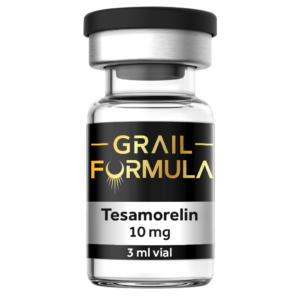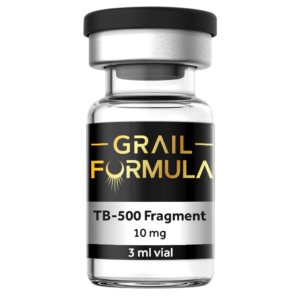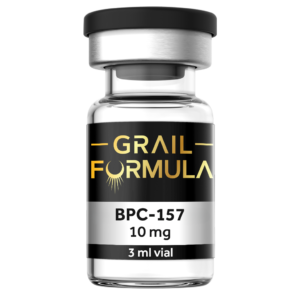
GHK-Cu + BPC-157 Blend 50mg / 10mg
€ 48,76 Original price was: € 48,76.€ 44,63Current price is: € 44,63.
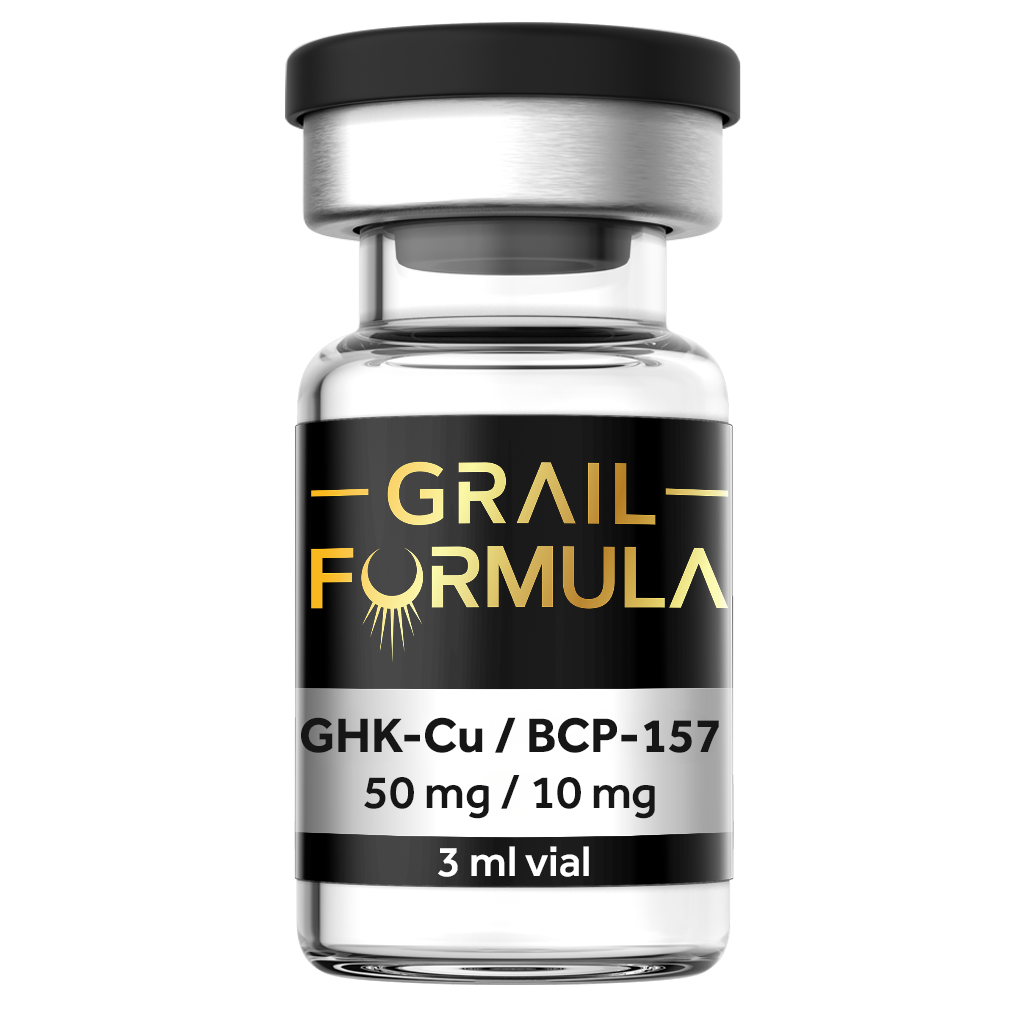
GHK-Cu 50 mg / BPC-157 10 mg – Grail Formula Quality.
Researched and verified with Liquilabs s.r.o. Czechia.
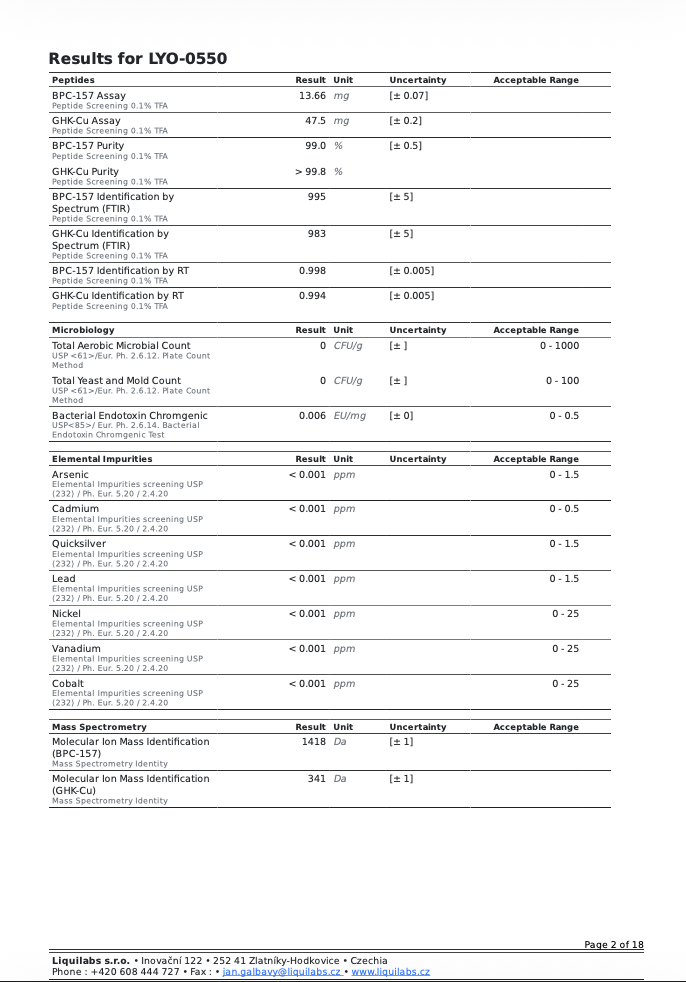
Analytical testing confirms greater than 99.8 % purity for GHK-Cu and 99.0 % purity for BPC-157, with molecular ion masses identified at 341 Da and 1418 Da respectively and bacterial endotoxin measured at 0.006 EU/mg.
Supplied as a 50 mg GHK-Cu / 10 mg BPC-157 lyophilized peptide preparation with full COA traceability.
For research use only — not for human or veterinary use.
Availability: In stock: ships within 1 day after payment confirmation.
Volume Discounts – the more you order, the more you save
5%
DISCOUNT
SPEND
€ 250+
10%
DISCOUNT
SPEND
€ 500+
15%
DISCOUNT
SPEND
€ 1.000+
20%
DISCOUNT
SPEND
€ 2.000+
25%
DISCOUNT
SPEND
€ 4.000+
Applied automatically at checkout based on your total cart value.
 | Secure Transaction |
GHK-Cu 50 mg / BPC-157 10 mg is a high-purity dual-peptide research preparation containing 50 mg GHK-Cu and 10 mg BPC-157, supplied exclusively for scientific investigation and controlled laboratory experimentation.
For research use only — not for human or veterinary use.
Product Overview
GHK-Cu 50 mg / BPC-157 10 mg is a dual-peptide research preparation combining two distinct peptide compounds within a single lyophilized research vial. GHK-Cu is a copper-binding tripeptide widely investigated within peptide chemistry, molecular signalling and cellular research models, while BPC-157 is a synthetic peptide research compound studied in experimental systems involving peptide-mediated signalling and biochemical interaction pathways. This research preparation contains 50 mg GHK-Cu together with 10 mg BPC-157, providing researchers with a combined peptide material for controlled laboratory investigation. Independent third-party laboratory analysis confirmed greater than 99.8 percent purity for GHK-Cu and 99.0 percent purity for BPC-157. Identity was further evaluated through FTIR spectrum analysis, retention time analysis and mass spectrometry. Molecular ion masses were identified at 341 Da for GHK-Cu and 1418 Da for BPC-157. Microbiological testing reported 0 CFU/g for both total aerobic microbial count and total yeast and mold count, while bacterial endotoxin analysis returned a result of 0.006 EU/mg. Comprehensive elemental impurity screening additionally reported arsenic, cadmium, mercury, lead, nickel, vanadium and cobalt below 0.001 ppm. These independently generated analytical results provide detailed batch-specific documentation regarding identity, purity, microbiological quality and analytical characteristics of this GHK-Cu 50 mg / BPC-157 10 mg research preparation.Peptide Overview
GHK-Cu and BPC-157 are structurally distinct peptide research compounds investigated across different areas of experimental peptide science, molecular biology and biochemical research. GHK-Cu consists of the peptide sequence glycyl-L-histidyl-L-lysine associated with copper, creating a copper-binding peptide complex frequently examined within controlled biochemical and cellular research systems. BPC-157 is a synthetic peptide research compound commonly investigated within laboratory models involving peptide signalling, molecular interactions and cellular response mechanisms. Combining 50 mg GHK-Cu and 10 mg BPC-157 within a single research preparation allows investigators to examine two chemically distinct peptide compounds under controlled experimental conditions. Because each peptide has its own analytical profile, Liquilabs independently evaluated assay content, purity, FTIR spectrum identity, retention time identity and molecular ion mass for both components.Historical Background and Scientific Context
Advances in modern peptide synthesis and analytical chemistry have made it possible to manufacture and characterise increasingly complex multi-component peptide research preparations. Individual peptide compounds within combined preparations can now be evaluated separately using complementary analytical techniques. Chromatographic methods provide information regarding assay content and purity, while FTIR spectrum analysis, retention time comparison and mass spectrometry provide additional molecular identity parameters. Microbiological analysis, bacterial endotoxin testing and elemental impurity screening further contribute to the analytical characterisation of lyophilized peptide research materials. GHK-Cu 50 mg / BPC-157 10 mg represents a dual-peptide preparation in which both peptide components have been independently characterised within the same production batch.Mechanistic Focus in Research
Within controlled laboratory environments, GHK-Cu and BPC-157 may be investigated in relation to peptide chemistry, cellular signalling and molecular interaction pathways. Research investigations may explore:- Peptide-mediated cellular signalling
- Copper-peptide complex research
- Cellular response mechanisms
- Molecular communication pathways
- Biochemical interaction systems
- Comparative peptide investigations
- Combined peptide research models
- Peptide chemistry investigations
- Controlled in vitro laboratory studies
Analytical Verification (COA)
Each Grail Formula production batch is supported by independent analytical documentation designed to provide transparent batch-specific information regarding the research material supplied. Analytical testing for this GHK-Cu 50 mg / BPC-157 10 mg production batch was performed by Liquilabs s.r.o. Czechia using chromatographic, spectroscopic, microbiological and mass spectrometric analytical techniques. Batch: GF-GHKBPC-B241- GHK-Cu Content: 50 mg
- GHK-Cu Purity: greater than 99.8 %
- GHK-Cu Identification by FTIR Spectrum: 983
- GHK-Cu Identification by Retention Time: 0.994
- GHK-Cu Molecular Ion Mass: 341 Da
- BPC-157 Content: 10 mg
- BPC-157 Purity: 99.0 %
- BPC-157 Identification by FTIR Spectrum: 995
- BPC-157 Identification by Retention Time: 0.998
- BPC-157 Molecular Ion Mass: 1418 Da
- Bacterial Endotoxins: 0.006 EU/mg
- Total Aerobic Microbial Count: 0 CFU/g
- Total Yeast and Mold Count: 0 CFU/g
Research Applications
Within controlled laboratory environments, GHK-Cu 50 mg / BPC-157 10 mg may be utilised in experimental models designed to investigate peptide biology, molecular signalling and biochemical interactions. Examples of research applications include:- GHK-Cu peptide-complex investigations
- BPC-157 peptide research
- Combined peptide interaction studies
- Peptide-mediated signalling research
- Cellular response investigations
- Molecular pathway analysis
- Comparative peptide studies
- Peptide chemistry research
- Controlled in vitro laboratory studies
Grail Formula Quality
Every Grail Formula research compound is supported by comprehensive independent analytical verification designed to provide transparent and traceable batch-specific documentation. For this GHK-Cu 50 mg / BPC-157 10 mg production batch, independent laboratory testing included:- Individual assay determination for GHK-Cu and BPC-157
- Individual purity assessment for both peptide components
- FTIR spectrum identification
- Retention time identity verification
- Molecular ion mass identification
- Bacterial endotoxin analysis
- Total aerobic microbial count
- Total yeast and mold count
- Comprehensive elemental impurity screening
- Complete batch-specific traceability
When You Choose Grail Formula
When selecting Grail Formula, researchers receive independently analysed research compounds supported by detailed Certificates of Analysis and transparent batch-specific laboratory documentation. For GHK-Cu 50 mg / BPC-157 10 mg batch GF-GHKBPC-B241, independent analysis was performed by Liquilabs s.r.o. Czechia and the Certificate of Analysis was published on 15 August 2026. Both peptide components were independently evaluated for assay content, purity, FTIR spectrum identity, retention time identity and molecular ion mass. The analytical programme additionally included bacterial endotoxin testing, microbiological analysis and comprehensive elemental impurity screening. This multi-method analytical approach provides researchers with extensive independent information regarding both peptide components within the tested research preparation.Research Use Limitation
- Used solely for laboratory and in vitro research
- Not approved for human consumption
- Not approved for veterinary use
- Not intended for diagnostic purposes
- Not intended for therapeutic applications
- Not permitted for clinical administration
- For research use only
- Independently analysed by Liquilabs s.r.o. Czechia
- Contains 50 mg GHK-Cu and 10 mg BPC-157
- GHK-Cu purity greater than 99.8 %
- BPC-157 purity confirmed at 99.0 %
- Identity evaluated by FTIR spectrum analysis
- Identity verified by retention time analysis
- GHK-Cu molecular ion mass identified at 341 Da
- BPC-157 molecular ion mass identified at 1418 Da
- Bacterial endotoxin level of 0.006 EU/mg
- Total aerobic microbial count: 0 CFU/g
- Total yeast and mold count: 0 CFU/g
- Seven tested elemental impurities below 0.001 ppm
- Complete batch-specific COA traceability
- For research use only – not for human or veterinary use
For laboratory research only. Not intended for human consumption, injection, or cosmetic use.
This product is for research purposes only. Not for human use or diagnostic/therapeutic applications. Keep out of reach of children.
Third-Party Tested
Public COAs
Batch Verified
EU Shipping