
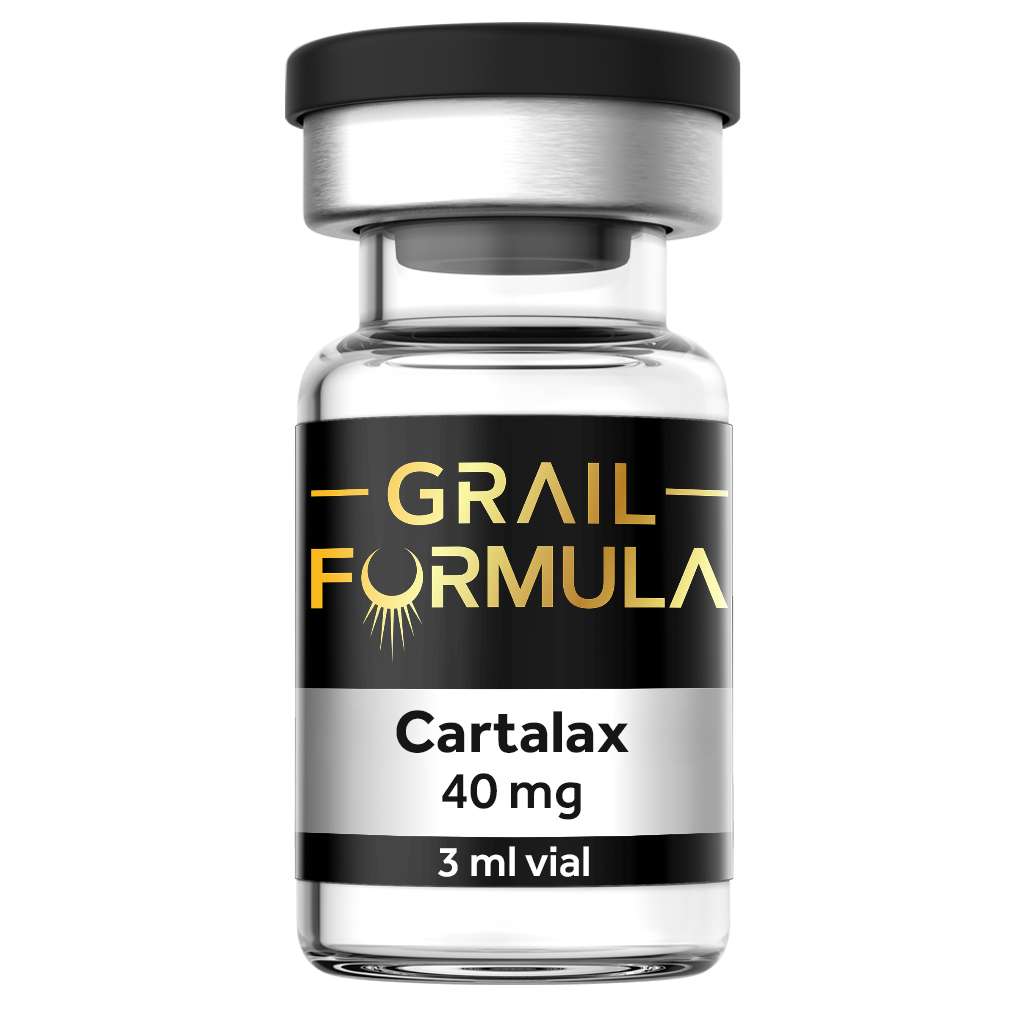
Cartalax 40mg
€ 144,00 Original price was: € 144,00.€ 129,00Current price is: € 129,00.
Cartalax 40 mg – Grail Formula Quality.
High-purity lyophilized Cartalax research peptide, independently analysed by Liquilabs s.r.o. Czechia.
Batch-specific laboratory testing confirms greater than 99.8% purity, with an assay content of 42.3 mg against the labelled 40 mg content.
Compound identity was evaluated through FTIR spectrum analysis, HPLC retention-time verification and mass spectrometry, with a reported molecular ion mass of 333 Da.
Additional testing includes bacterial endotoxins (0.004 EU/mg), microbiological analysis, elemental impurity screening, extended counter-ion analysis and mannitol quantification.
For research use only — not for human or veterinary use.
Availability: In stock: ships within 1 day after payment confirmation.
Volume Discounts – the more you order, the more you save
5%
DISCOUNT
SPEND
€ 250+
10%
DISCOUNT
SPEND
€ 500+
15%
DISCOUNT
SPEND
€ 1.000+
20%
DISCOUNT
SPEND
€ 2.000+
25%
DISCOUNT
SPEND
€ 4.000+
Applied automatically at checkout based on your total cart value.
 | Secure Transaction |
Cartalax 40 mg – Independently Verified Research Peptide
Cartalax 40 mg – Grail Formula Quality.
Cartalax 40 mg is a high-purity lyophilized research peptide supplied for controlled scientific investigation and laboratory experimentation. This production batch has undergone extensive independent third-party analytical testing by Liquilabs s.r.o., Czechia.
Independent analysis confirmed a measured Cartalax content of 42.3 mg against the labelled 40 mg content, with chromatographic purity reported at greater than 99.8%.
Beyond conventional peptide assay and purity testing, this batch was evaluated through FTIR spectrum identification, HPLC retention-time verification, mass spectrometry, bacterial endotoxin analysis, microbiological testing, elemental impurity screening, extended counter-ion analysis and mannitol determination.
These additional analytical measurements provide researchers with greater transparency regarding the composition and characteristics of the tested material.
For research use only. Not for human or veterinary use.
Product Overview
Cartalax is a synthetic tripeptide investigated within peptide chemistry, molecular biology and experimental biochemical research.
It is commonly described in scientific literature as the tripeptide Ala-Glu-Asp (AED), consisting of three amino acid residues:
- Alanine (Ala)
- Glutamic acid (Glu)
- Aspartic acid (Asp)
Short-chain peptides are studied because their defined amino acid sequences provide useful molecular structures for investigating biochemical interactions, peptide stability and molecular signalling.
Cartalax belongs to the broader category of short synthetic peptides investigated in experimental peptide research.
For this particular production batch, independent analytical testing measured:
- Labelled peptide content: 40 mg
- Measured assay content: 42.3 mg
- Chromatographic purity: greater than 99.8%
- FTIR spectrum identification: 997
- HPLC retention-time identification: 0.990
- Molecular ion mass identification: 333 Da
These results provide multiple analytical measurements for evaluating the identity, content and chromatographic characteristics of the tested Cartalax material.
Scientific Background of Cartalax
Short synthetic peptides have become an important subject within molecular and biochemical research because their relatively simple structures allow researchers to investigate sequence-specific molecular interactions under controlled experimental conditions.
Cartalax is associated with research involving short-chain peptides and bioregulator-related experimental models.
Scientific investigations involving peptides of this category may explore molecular signalling, gene-expression-related mechanisms, cellular biochemical processes and peptide interactions within laboratory systems.
Such research remains distinct from demonstrating clinical effectiveness or therapeutic benefit.
The presence, identity and analytical purity of a peptide do not establish its biological activity, clinical safety or effectiveness in humans.
The Certificate of Analysis supplied with this Cartalax batch documents laboratory measurements of the tested material. It does not constitute a clinical evaluation or proof of any therapeutic outcome.
Research Areas and Molecular Investigation
Cartalax may be investigated within controlled experimental environments involving short-chain peptide chemistry and biochemical research.
Potential scientific research contexts include:
- Short-chain peptide characterisation
- Peptide sequence and molecular structure investigations
- Peptide-associated cellular signalling research
- Biochemical interaction studies
- Experimental gene-expression research
- Peptide stability investigations
- Comparative peptide analysis
- Molecular biology research
- Controlled in vitro experimental models
These are areas of scientific investigation and should not be interpreted as established physiological effects or medical applications of this product.
Independent Third-Party Laboratory Verification
Grail Formula places particular emphasis on independent analytical verification and transparent batch-specific documentation.
This Cartalax 40 mg production batch was submitted for analysis to Liquilabs s.r.o., Czechia, an independent analytical laboratory.
The resulting Certificate of Analysis contains measurements covering several different aspects of the tested material.
Certificate of Analysis Information:
- Product: Cartalax 40 mg
- Batch number: GF-CARTA40-B241
- Laboratory report: LYO-1183
- Laboratory: Liquilabs s.r.o., Czechia
- Publication date: 10 November 2026
- Analytical documentation: 15-page Certificate of Analysis
The analytical programme covers peptide content, chromatographic purity, compound identity, microbiological quality, bacterial endotoxins, elemental impurities, counter-ion composition and mannitol content.
Each measurement provides information about a different characteristic of the tested research material.
Assay Verification – Actual Peptide Content
One of the most important measurements when evaluating a research peptide is the assay result.
Assay testing determines the measured amount of the target compound within the analysed sample.
For this Cartalax batch, Liquilabs reported:
- Labelled content: 40 mg
- Measured Cartalax assay: 42.3 mg
- Reported measurement uncertainty: ±0.2 mg
The measured assay content is therefore approximately 5.75% above the labelled 40 mg quantity.
This distinction matters because a product’s stated content and its actual measured peptide quantity are not necessarily identical.
Independent assay verification provides researchers with a documented measurement rather than relying exclusively on the quantity stated on the product label.
Chromatographic Purity – Greater Than 99.8%
Chromatographic purity analysis evaluates the relative chromatographic contribution of the target compound compared with other detected components under the analytical conditions used.
For this production batch, Liquilabs reported:
Cartalax Purity: Greater than 99.8%
This result indicates a high level of chromatographic purity within the scope of the laboratory’s analytical method.
However, purity and assay are not interchangeable measurements.
A purity percentage does not independently establish the total amount of active peptide present in a vial, nor does it describe the total mass of excipients, counter-ions or other non-peptide constituents.
For this reason, Grail Formula presents both the assay result and the chromatographic purity result separately.
The combination of 42.3 mg measured assay content and greater than 99.8% chromatographic purity provides a more informative analytical description than a purity percentage alone.
Compound Identity Verification
Determining peptide content and chromatographic purity is only part of a comprehensive analytical assessment.
Researchers also need analytical information supporting the identity of the compound being evaluated.
For this Cartalax batch, Liquilabs reported three complementary identity-related measurements:
- FTIR spectrum identification: 997
- HPLC retention-time identification: 0.990
- Molecular ion mass identification: 333 Da
These measurements provide additional information supporting the laboratory’s identification of the tested material as Cartalax.
FTIR Spectrum Identification
Fourier-transform infrared spectroscopy, commonly abbreviated as FTIR, evaluates infrared spectral characteristics associated with molecular chemical bonds.
The reported FTIR identification result for this batch was 997.
This provides an additional spectroscopic identification parameter alongside the chromatographic and mass-spectrometric measurements.
HPLC Retention-Time Identification
High-performance liquid chromatography allows compounds to be separated and evaluated under defined analytical conditions.
Retention-time comparison is one of the parameters used during compound identification.
For this Cartalax batch, Liquilabs reported a retention-time identification result of 0.990.
Mass Spectrometry Identification
Mass spectrometry provides information concerning the mass-to-charge characteristics of detected molecular ions.
The laboratory reported a molecular ion mass identification result of 333 Da, with a stated uncertainty of ±1 Da.
The complete Certificate of Analysis includes the associated chromatographic and mass-spectrometric analytical documentation.
Microbiological Quality Testing
Microbiological testing is an additional component of the independent analytical assessment.
For this Cartalax production batch, Liquilabs performed microbiological testing covering aerobic microorganisms and yeast and mold.
Reported results:
- Total Aerobic Microbial Count (TAMC): 0 CFU/g
- Total Yeast and Mold Count (TYMC): 0 CFU/g
Both measurements were reported as zero colony-forming units per gram in the tested sample.
These measurements provide information about microbiological contamination under the specific test conditions.
Microbiological count testing should not be confused with a validated sterility test. A result of 0 CFU/g does not independently establish that a product is sterile.
Bacterial Endotoxin Analysis
Bacterial endotoxins are substances associated with the outer membranes of certain Gram-negative bacteria.
Endotoxin analysis is a separate analytical measurement from conventional microbiological counting.
A sample may have a low microbial count while still requiring separate endotoxin evaluation, because microbial counts and endotoxin concentrations measure different characteristics.
For this Cartalax batch, Liquilabs reported:
Bacterial Endotoxin Result: 0.004 EU/mg
The laboratory’s reported acceptance range for this test was 0–0.5 EU/mg.
The measured result was therefore within the acceptance range specified in the Certificate of Analysis.
This result contributes to the batch-specific analytical profile but does not establish sterility or suitability for administration.
Elemental Impurity and Heavy Metal Screening
Elemental impurity analysis provides additional information concerning trace elements that may be present in a research material.
For this Cartalax batch, Liquilabs performed screening for seven elements.
Reported elemental impurity results:
- Arsenic: less than 0.001 ppm
- Cadmium: less than 0.001 ppm
- Mercury: less than 0.001 ppm
- Lead: less than 0.001 ppm
- Nickel: less than 0.001 ppm
- Vanadium: less than 0.001 ppm
- Cobalt: less than 0.001 ppm
Each of the seven tested elements was reported below 0.001 parts per million.
These results provide an additional layer of analytical characterisation beyond peptide identity, assay and purity.
The findings relate specifically to the tested elements and should not be interpreted as a measurement of every possible elemental impurity.
Advanced Counter-Ion Analysis – Beyond Standard Peptide Testing
One of the additional analytical features of this Cartalax Certificate of Analysis is the inclusion of extended counter-ion testing.
Many peptide Certificates of Analysis focus primarily on identity and chromatographic purity. However, these measurements do not fully describe the ionic composition of a peptide preparation.
Counter-ion analysis provides additional information about specific ions present within the tested material.
Counter-ions can be associated with peptide synthesis, purification, salt formation and other manufacturing processes.
For this Cartalax production batch, Liquilabs reported the following results:
| Counter-Ion | Measured Result |
|---|---|
| Acetate | 11.82 ppm |
| Bromide | 0.15 ppm |
| Chloride | 0.29 ppm |
| Fluoride | 0.00 ppm |
| Nitrate | 0.24 ppm |
| Phosphate | 0.41 ppm |
| Sulphate | 0.00 ppm |
| TFA | 24.11 ppm |
These measurements provide a more detailed analytical description of the ionic constituents detected by the laboratory’s counter-ion testing method.
They should not be interpreted as a complete elemental or chemical composition of the entire vial.
What Is TFA and Why Is It Tested?
TFA stands for trifluoroacetic acid.
TFA is commonly associated with peptide manufacturing and analytical procedures, including certain synthesis and purification processes.
Depending on the manufacturing process and the chemical form of the peptide, trifluoroacetate may remain associated with peptide material.
For this Cartalax production batch, Liquilabs measured:
TFA: 24.11 ppm
The Certificate of Analysis reports a measurement uncertainty of ±0.48 ppm.
Reporting the measured TFA concentration provides researchers with additional analytical information that is not captured by a conventional chromatographic purity percentage alone.
A high peptide purity result does not necessarily establish the absence of TFA or other counter-ions.
Likewise, the detection of TFA does not by itself establish whether a preparation is suitable for a particular experimental application. Interpretation depends on the analytical method, the experimental context and relevant research specifications.
Grail Formula reports the measured TFA concentration transparently so that researchers can evaluate the actual laboratory data.
Acetate and Other Counter-Ions
In addition to TFA, the laboratory evaluated acetate and several other ionic constituents.
Acetate was reported at 11.82 ppm, while smaller concentrations were reported for bromide, chloride, nitrate and phosphate.
Fluoride and sulphate were each reported at 0.00 ppm.
These findings provide additional information about the tested preparation.
Different counter-ions can have different chemical properties, and their presence or concentration may be relevant when researchers evaluate peptide materials for specific experimental protocols.
However, the counter-ion analysis does not establish the complete salt form of the peptide or independently determine biological activity.
The measurements should be interpreted as laboratory results for the individual ionic constituents specified in the report.
Mannitol Quantification – Understanding Excipients
Another important addition to this Certificate of Analysis is the inclusion of mannitol testing.
Mannitol is a sugar alcohol that is commonly used as an excipient in pharmaceutical and laboratory formulations.
In lyophilized preparations, mannitol may be used as a bulking agent or to support the physical characteristics of the freeze-dried material.
Mannitol is not itself the Cartalax peptide.
For this production batch, Liquilabs reported:
Mannitol Content: Greater than 100 mg
This is a threshold result rather than an exact quantified amount.
The report therefore establishes that the measured mannitol content exceeded 100 mg, but it does not provide a precise final mass above that threshold.
This distinction is important when interpreting the composition of a lyophilized research vial.
The visible amount of freeze-dried material does not necessarily correspond to the quantity of peptide present because the preparation may contain additional constituents, including excipients.
For this Cartalax batch, the laboratory separately reported 42.3 mg Cartalax assay content and greater than 100 mg mannitol.
These are different measurements referring to different components of the preparation.
The presence of mannitol is not inherently evidence of poor quality. Its relevance depends on the intended formulation, the quantity present and the requirements of the particular research application.
By reporting both peptide assay and mannitol content, the Certificate of Analysis provides researchers with more complete information about the tested material.
Why Peptide Purity Alone Is Not Enough
A Certificate of Analysis reporting only a high chromatographic purity percentage provides limited information about the complete composition of a research material.
For example, chromatographic purity alone does not necessarily answer the following questions:
- How many milligrams of the target peptide were measured?
- Was the molecular identity evaluated?
- What bacterial endotoxin concentration was reported?
- Were microbiological tests performed?
- Were elemental impurities evaluated?
- What concentrations of specific counter-ions were detected?
- Was TFA measured?
- Does the formulation contain mannitol?
- How much mannitol was reported?
For this Cartalax production batch, the independent laboratory evaluated each of these analytical categories.
The resulting documentation provides a broader picture of the tested material than chromatographic purity testing alone.
Importantly, even comprehensive analytical testing does not establish every possible property of a product. The findings remain limited to the tests performed and the samples analysed.
Comprehensive Analytical Verification
The independent analytical programme for Cartalax 40 mg includes:
- Peptide assay determination
- Chromatographic purity analysis
- FTIR spectrum identification
- HPLC retention-time identification
- Mass-spectrometry identity analysis
- Total Aerobic Microbial Count testing
- Total Yeast and Mold Count testing
- Bacterial endotoxin analysis
- Seven-element impurity screening
- Acetate quantification
- Bromide quantification
- Chloride quantification
- Fluoride analysis
- Nitrate quantification
- Phosphate quantification
- Sulphate analysis
- TFA quantification
- Mannitol determination
- Batch-specific analytical documentation
This approach makes it possible to review multiple independently reported characteristics of the tested Cartalax material.
Grail Formula – Transparent Research Quality
At Grail Formula, we believe research material should be evaluated through measurable analytical data rather than relying exclusively on supplier descriptions or product labels.
Our approach emphasises independent third-party testing and transparent presentation of batch-specific results.
For Cartalax 40 mg, the laboratory measured 42.3 mg peptide content with greater than 99.8% chromatographic purity.
The analysis also documented compound identity, bacterial endotoxins, microbiological results and elemental impurities.
With the addition of counter-ion testing and mannitol determination, the analytical documentation provides further insight into the composition of the tested research material.
These measurements are presented individually because different analytical parameters answer different scientific questions.
Researchers can review the complete Certificate of Analysis and assess the reported values according to their own experimental requirements.
Why Choose Grail Formula?
Grail Formula focuses on independently characterised research materials supported by transparent analytical documentation.
Key characteristics of this Cartalax 40 mg batch include:
- Independent third-party laboratory testing
- 42.3 mg measured peptide assay
- Greater than 99.8% chromatographic purity
- Multiple compound identity measurements
- 0.004 EU/mg bacterial endotoxin result
- 0 CFU/g reported for both microbiological counts
- Seven tested elemental impurities below 0.001 ppm
- Extended counter-ion analysis
- Documented TFA concentration
- Documented mannitol result
- Batch-specific Certificate of Analysis
- Transparent reporting of actual laboratory measurements
Rather than presenting a single purity figure as a complete description of quality, Grail Formula provides access to the additional analytical parameters available for the tested batch.
Storage and Laboratory Handling
Cartalax 40 mg is supplied as a lyophilized research peptide.
Storage and handling should follow appropriate laboratory procedures and any validated stability information available for the material.
Research personnel should protect the material from unnecessary environmental exposure and use suitable laboratory equipment and established procedures.
Any preparation or experimental handling should be performed exclusively within an appropriate laboratory environment by qualified personnel.
The Certificate of Analysis does not establish a specific shelf life, reconstitution stability or validated storage duration.
Research Use Only
Cartalax 40 mg is intended exclusively for scientific and laboratory research.
- For laboratory research only
- Not for human consumption
- Not for veterinary use
- Not intended for self-administration
- Not approved for therapeutic use
- Not intended to diagnose, prevent or treat disease
- Not intended for clinical administration
- Not a medicinal product
The analytical results relate to the tested sample and do not constitute proof of sterility, clinical safety or therapeutic effectiveness.
Cartalax 40 mg – Grail Formula Quality. Independently analysed, transparently documented and supplied exclusively for scientific research.
- Cartalax 40 mg lyophilized research peptide
- Independently tested by Liquilabs s.r.o. Czechia
- Measured assay content: 42.3 mg
- Chromatographic purity: greater than 99.8%
- FTIR spectrum identification: 997
- HPLC retention-time identification: 0.990
- Molecular ion mass identification: 333 Da
- Bacterial endotoxin result: 0.004 EU/mg
- Total Aerobic Microbial Count: 0 CFU/g
- Total Yeast and Mold Count: 0 CFU/g
- Arsenic, cadmium, mercury, lead, nickel, vanadium and cobalt: each below 0.001 ppm
- Extended counter-ion analysis, including TFA and acetate
- TFA concentration: 24.11 ppm
- Acetate concentration: 11.82 ppm
- Additional screening for bromide, chloride, fluoride, nitrate, phosphate and sulphate
- Mannitol content reported as greater than 100 mg
- Batch-specific Certificate of Analysis available
- For research use only – not for human or veterinary use
For laboratory research only. Not intended for human consumption, injection, or cosmetic use.
This product is for research purposes only. Not for human use or diagnostic/therapeutic applications. Keep out of reach of children.
Third-Party Tested
Public COAs
Batch Verified
EU Shipping
Related Products


€ 59,00 Original price was: € 59,00.€ 54,00Current price is: € 54,00.
€ 139,00 Original price was: € 139,00.€ 124,00Current price is: € 124,00.