
TB-500 (Thymosin Beta-4) 20mg
€ 129,00 Original price was: € 129,00.€ 114,00Current price is: € 114,00.
TB-500 (Thymosin Beta-4) 20 mg – Grail Formula Quality.
Researched and verified with Liquilabs s.r.o. Czechia.
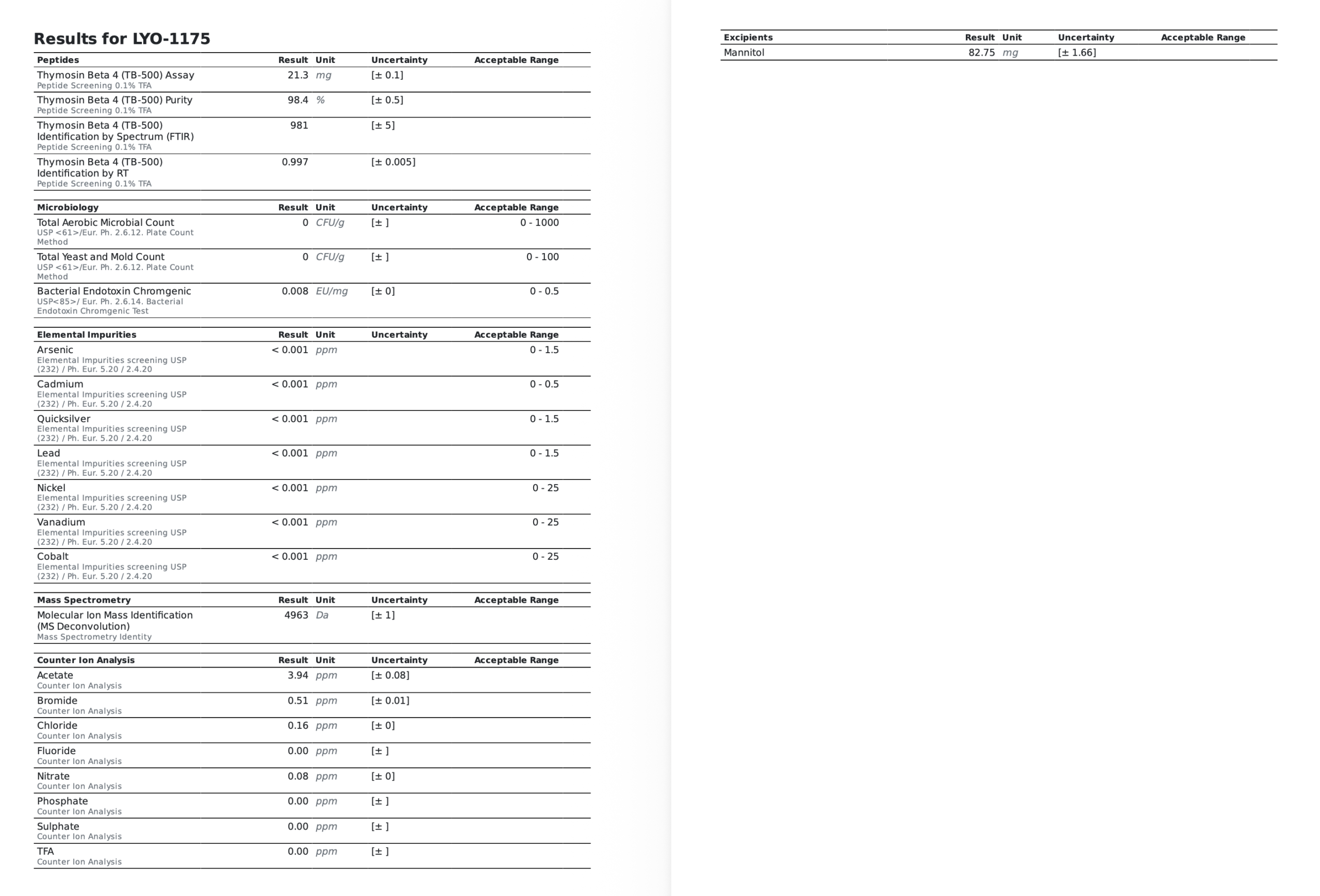
Analytical testing reports 98.4% purity, assay content measured at 21.3 mg, molecular ion mass identified at 4963 Da and bacterial endotoxin measured at 0.008 EU/mg.
Supplied as a nominal 20 mg lyophilized research peptide with full batch-specific COA traceability, including counter ion and mannitol analysis.
For research use only — not for human or veterinary use.
Availability: In stock: ships within 1 day after payment confirmation.
Volume Discounts – the more you order, the more you save
5%
DISCOUNT
SPEND
€ 250+
10%
DISCOUNT
SPEND
€ 500+
15%
DISCOUNT
SPEND
€ 1.000+
20%
DISCOUNT
SPEND
€ 2.000+
25%
DISCOUNT
SPEND
€ 4.000+
Applied automatically at checkout based on your total cart value.

 | Secure Transaction |
TB-500 (Thymosin Beta-4) 20 mg is a lyophilized synthetic peptide research compound supplied exclusively for scientific investigation and controlled in vitro laboratory experimentation. Its defined molecular structure and comprehensive batch-specific analytical documentation make it relevant to research involving peptide chemistry, actin-associated molecular interactions, cytoskeletal organisation and intracellular regulatory mechanisms.
For research use only — not for human or veterinary use.
Product Overview
TB-500, identified as Thymosin Beta-4 in the accompanying Certificate of Analysis, is a synthetic peptide research compound investigated within experimental molecular biology, cellular biology and peptide science.
Thymosin Beta-4 belongs to the beta-thymosin family of peptides, which has attracted scientific interest because of its association with actin-binding mechanisms and intracellular cytoskeletal organisation.
This preparation is supplied as a nominal 20 mg lyophilized research peptide. Independent analytical testing performed by Liquilabs s.r.o. Czechia measured an assay content of 21.3 ± 0.1 mg and chromatographic purity of 98.4 ± 0.5%.
Molecular identity was evaluated through FTIR spectrum identification, retention time analysis and mass spectrometry, with a reported molecular ion mass of 4963 ± 1 Da.
Additional analytical testing included bacterial endotoxin determination, microbiological assessment, elemental impurity screening, counter ion analysis and quantitative mannitol determination.
These complementary analytical procedures provide researchers with detailed batch-specific information regarding the identity, measured content, chromatographic purity and compositional characteristics of the tested research preparation.
Peptide Overview
Thymosin Beta-4 is a naturally occurring peptide consisting of 43 amino acid residues. It belongs to the beta-thymosin family, a group of structurally related peptides investigated in relation to intracellular actin-associated molecular mechanisms.
The full-length Thymosin Beta-4 peptide contains molecular regions associated with interactions involving monomeric globular actin, commonly referred to as G-actin.
Within experimental molecular biology, these interactions provide a scientific framework for investigating relationships between peptide structure, protein recognition and cytoskeletal organisation.
The molecular structure of Thymosin Beta-4 is relevant to comparative investigations involving actin-binding peptides, amino acid sequences and peptide–protein structure–function relationships.
The designation TB-500 is used in accordance with the accompanying Certificate of Analysis, which identifies the tested compound as Thymosin Beta-4 and reports a molecular ion mass of 4963 Da.
Chromatographic analysis, spectroscopic identification and mass spectrometry provide complementary analytical approaches for evaluating the identity, measured peptide content and chromatographic purity of the tested preparation.
Additional counter ion and excipient analyses provide information regarding the non-peptide composition of the lyophilized research material.
Historical Background and Scientific Context
The scientific background of Thymosin Beta-4 is associated with investigations into naturally occurring thymosin peptides and their molecular characteristics.
Early research into thymosin fractions contributed to the identification and characterisation of multiple peptide families with distinct amino acid sequences and biochemical properties.
Thymosin Beta-4 was subsequently investigated in relation to intracellular actin-binding mechanisms, contributing to scientific understanding of the molecular processes associated with cytoskeletal organisation.
Actin represents an important research target within experimental cellular biology because of its involvement in cellular architecture, intracellular organisation and dynamic molecular interactions.
Research involving Thymosin Beta-4 has contributed to broader investigations into the relationships between actin-binding proteins, peptide-associated molecular recognition and cellular regulatory mechanisms.
Advances in synthetic peptide chemistry have improved the ability to manufacture and characterise defined peptide sequences for controlled laboratory investigation.
Modern analytical technologies, including liquid chromatography and mass spectrometry, allow researchers to assess molecular identity, chromatographic purity and quantitative peptide content.
These techniques can be complemented by microbiological testing, bacterial endotoxin determination, elemental impurity screening, counter ion analysis and excipient quantification.
Together, these analytical approaches provide a broader understanding of the composition and measurable characteristics of individual research preparations.
Mechanistic Focus in Research
Within controlled laboratory environments, Thymosin Beta-4 may be investigated in relation to actin-associated molecular interactions, cytoskeletal organisation and intracellular regulatory mechanisms.
One established area of scientific investigation concerns the interaction between Thymosin Beta-4 and monomeric G-actin. These molecular interactions are relevant to research examining the relationship between actin-binding peptides and cytoskeletal dynamics.
Experimental investigations may examine peptide–protein recognition, molecular binding characteristics and the structural features associated with actin-related biochemical processes.
Comparative research involving full-length Thymosin Beta-4 and related peptide fragments may also explore relationships between amino acid composition, molecular configuration and protein-binding characteristics.
Relevant mechanistic research areas include:
- Thymosin Beta-4 peptide chemistry
- Actin-binding peptide investigations
- G-actin-associated molecular interactions
- Cytoskeletal organisation and molecular dynamics
- Peptide–protein recognition mechanisms
- Actin polymerisation-associated research
- Intracellular biochemical regulation
- Peptide structure–function relationship studies
- Comparative beta-thymosin peptide investigations
- Controlled in vitro molecular studies
These research areas describe the scientific context associated with Thymosin Beta-4. They do not establish functional biological activity, experimental performance or therapeutic effectiveness for the tested production batch.
Analytical Verification (COA)
Independent analytical testing of this TB-500 (Thymosin Beta-4) production batch was performed by Liquilabs s.r.o. Czechia. The Certificate of Analysis includes peptide screening, molecular identity assessment, microbiological testing, bacterial endotoxin determination, elemental impurity screening, counter ion analysis and excipient quantification.
Batch: GF-TB50020-B242
Sample: LYO-1175
COA Publication Date: 10 November 2026
Peptide Analysis and Molecular Identification
- Nominal Peptide Content: 20 mg
- Assay Content: 21.3 ± 0.1 mg
- Purity: 98.4 ± 0.5%
- Identification by Spectrum (FTIR): 981 ± 5
- Identification by Retention Time: 0.997 ± 0.005
- Molecular Ion Mass Identification (MS Deconvolution): 4963 ± 1 Da
Independent peptide screening measured an assay content of 21.3 mg with a reported analytical uncertainty of ±0.1 mg.
Chromatographic purity was reported at 98.4%, with an analytical uncertainty of ±0.5 percentage points.
Complementary molecular identity parameters were obtained through FTIR spectrum identification, retention time analysis and mass spectrometry.
Molecular ion mass identification through MS deconvolution returned a reported result of 4963 Da, with an analytical uncertainty of ±1 Da.
These analytical results provide batch-specific information regarding the measured peptide content, chromatographic purity and molecular identity of the tested Thymosin Beta-4 research preparation.
Microbiological Analysis and Bacterial Endotoxins
- Bacterial Endotoxins: 0.008 EU/mg (reported uncertainty: ±0 EU/mg)
- Total Aerobic Microbial Count: 0 CFU/g
- Total Yeast and Mold Count: 0 CFU/g
Bacterial endotoxin analysis was performed using a chromogenic test. The reported result of 0.008 EU/mg falls within the laboratory’s stated acceptable range of 0–0.5 EU/mg.
Both microbiological counts were reported as 0 CFU/g under the applied plate count methods and fall within the respective laboratory acceptance ranges.
These microbiological results characterise the tested sample and do not establish sterility or suitability for administration.
Elemental Impurity Screening
- Arsenic (As): <0.001 ppm
- Cadmium (Cd): <0.001 ppm
- Mercury (Hg): <0.001 ppm
- Lead (Pb): <0.001 ppm
- Nickel (Ni): <0.001 ppm
- Vanadium (V): <0.001 ppm
- Cobalt (Co): <0.001 ppm
All seven screened elemental impurities were reported below 0.001 ppm and within their respective laboratory acceptance ranges.
Elemental impurity screening provides additional analytical information regarding the inorganic impurity profile of the tested research material.
Counter Ion Analysis
- Acetate: 3.94 ± 0.08 ppm
- Bromide: 0.51 ± 0.01 ppm
- Chloride: 0.16 ppm (reported uncertainty: ±0 ppm)
- Fluoride: 0.00 ppm
- Nitrate: 0.08 ppm (reported uncertainty: ±0 ppm)
- Phosphate: 0.00 ppm
- Sulphate: 0.00 ppm
- Trifluoroacetic Acid (TFA): 0.00 ppm
Counter ion analysis provides additional information regarding the ionic composition of the tested peptide preparation. Acetate was the predominant reported analyte among the eight measured parameters.
Fluoride, phosphate, sulphate and trifluoroacetic acid were each reported at 0.00 ppm. These values reflect the laboratory’s reported analytical results and should not be interpreted as evidence of absolute absence.
The inclusion of counter ion analysis provides researchers with additional compositional information beyond conventional peptide identity, assay content and chromatographic purity measurements.
Excipient Analysis
- Mannitol Content: 82.75 ± 1.66 mg
Mannitol is a sugar alcohol commonly used as a bulking excipient in lyophilized preparations. Its quantitative determination provides additional information regarding the non-peptide composition of the tested research material.
Independent excipient analysis measured a mannitol content of 82.75 mg with a reported analytical uncertainty of ±1.66 mg.
The reported mannitol content is separate from the measured Thymosin Beta-4 assay content. Chromatographic peptide purity should therefore not be interpreted as the percentage of Thymosin Beta-4 by weight within the complete lyophilized preparation.
Together, these analytical procedures provide detailed batch-specific documentation of peptide identity, measured content, chromatographic purity, microbiological characteristics, elemental impurities, counter ions and excipient composition.
Research Applications
TB-500 (Thymosin Beta-4) may be investigated within controlled laboratory models focusing on peptide chemistry, actin-associated molecular interactions, cytoskeletal organisation and intracellular biochemical mechanisms.
Its defined molecular structure and documented analytical characteristics provide information relevant to comparative peptide investigations, molecular characterisation and experimental material assessment.
Examples of research applications include:
- Thymosin Beta-4 peptide chemistry and molecular characterisation
- Actin-binding peptide investigations
- G-actin-associated biochemical research
- Cytoskeletal organisation and molecular dynamics
- Peptide–protein interaction studies
- Intracellular regulatory pathway investigations
- Comparative beta-thymosin peptide research
- Peptide structure–function relationship studies
- Chromatographic and mass spectrometric peptide characterisation
- Counter ion and excipient composition studies
- Controlled in vitro molecular investigations
All described research applications are intended exclusively for scientific investigation under appropriate laboratory conditions.
Grail Formula Quality
Grail Formula emphasises analytical transparency through independent third-party laboratory testing and batch-specific Certificates of Analysis.
For this TB-500 (Thymosin Beta-4) production batch, the analytical programme included:
- Peptide assay content determination
- Chromatographic purity assessment
- FTIR spectrum identification
- Retention time identification
- Molecular ion mass identification through MS deconvolution
- Chromogenic bacterial endotoxin determination
- Microbiological plate count analysis
- Seven-element impurity screening
- Eight-analyte counter ion analysis
- Quantitative mannitol determination
- Batch-specific analytical documentation
The inclusion of counter ion and excipient analysis provides additional compositional information beyond conventional peptide identity, assay and purity measurements.
Independent laboratory documentation supports transparent research material assessment by providing measurable information relating directly to the tested sample rather than relying exclusively on nominal product specifications.
This multi-method analytical approach supports compositional transparency and batch-specific traceability throughout the research material assessment process.
When You Choose Grail Formula
When selecting Grail Formula, researchers receive peptide research materials supported by independent analytical documentation and identifiable production batch information.
For TB-500 (Thymosin Beta-4) 20 mg batch GF-TB50020-B242, independent laboratory analysis was performed by Liquilabs s.r.o. Czechia, with the Certificate of Analysis published on 10 November 2026.
The analytical report documents peptide assay content, chromatographic purity, molecular identity, microbiological characteristics, bacterial endotoxins, elemental impurities, counter ions and mannitol content.
By providing detailed batch-specific analytical results, Grail Formula supports informed research material selection, compositional transparency and controlled scientific investigation.
Research Use Limitation
Used solely for in vitro experiments and cannot be:
- Used in clinical trials involving humans
- Administered to humans as part of an experiment or investigation
- Supplied to another party for human investigational use.
- Product: TB-500 (Thymosin Beta-4) 20 mg
- Brand: Grail Formula
- Form: Lyophilized synthetic research peptide
- Independent Laboratory: Liquilabs s.r.o. Czechia
- Batch Number: GF-TB50020-B242
- Sample Identification: LYO-1175
- Assay Content: 21.3 ± 0.1 mg
- Purity: 98.4 ± 0.5%
- FTIR Spectrum Identification: 981 ± 5
- Retention Time Identification: 0.997 ± 0.005
- Molecular Ion Mass Identification (MS Deconvolution): 4963 ± 1 Da
- Bacterial Endotoxins: 0.008 EU/mg (reported uncertainty: ±0 EU/mg)
- Total Aerobic Microbial Count: 0 CFU/g
- Total Yeast and Mold Count: 0 CFU/g
- Elemental Impurities: As, Cd, Hg, Pb, Ni, V and Co each <0.001 ppm
- Acetate: 3.94 ± 0.08 ppm
- Bromide: 0.51 ± 0.01 ppm
- Chloride: 0.16 ± 0 ppm
- Fluoride: 0.00 ppm
- Nitrate: 0.08 ± 0 ppm
- Phosphate: 0.00 ppm
- Sulphate: 0.00 ppm
- Trifluoroacetic Acid (TFA): 0.00 ppm
- Mannitol Content: 82.75 ± 1.66 mg
- COA Publication Date: 10 November 2026
- Research Limitation: For laboratory and in vitro research only; not for human or veterinary use
For laboratory research only. Not intended for human consumption, injection, or cosmetic use.
This product is for research purposes only. Not for human use or diagnostic/therapeutic applications. Keep out of reach of children.
Third-Party Tested
Public COAs
Batch Verified
EU Shipping