BPC-157 + TB-500 Blend. 30mg / 30mg
€ 189,00 Original price was: € 189,00.€ 169,00Current price is: € 169,00.
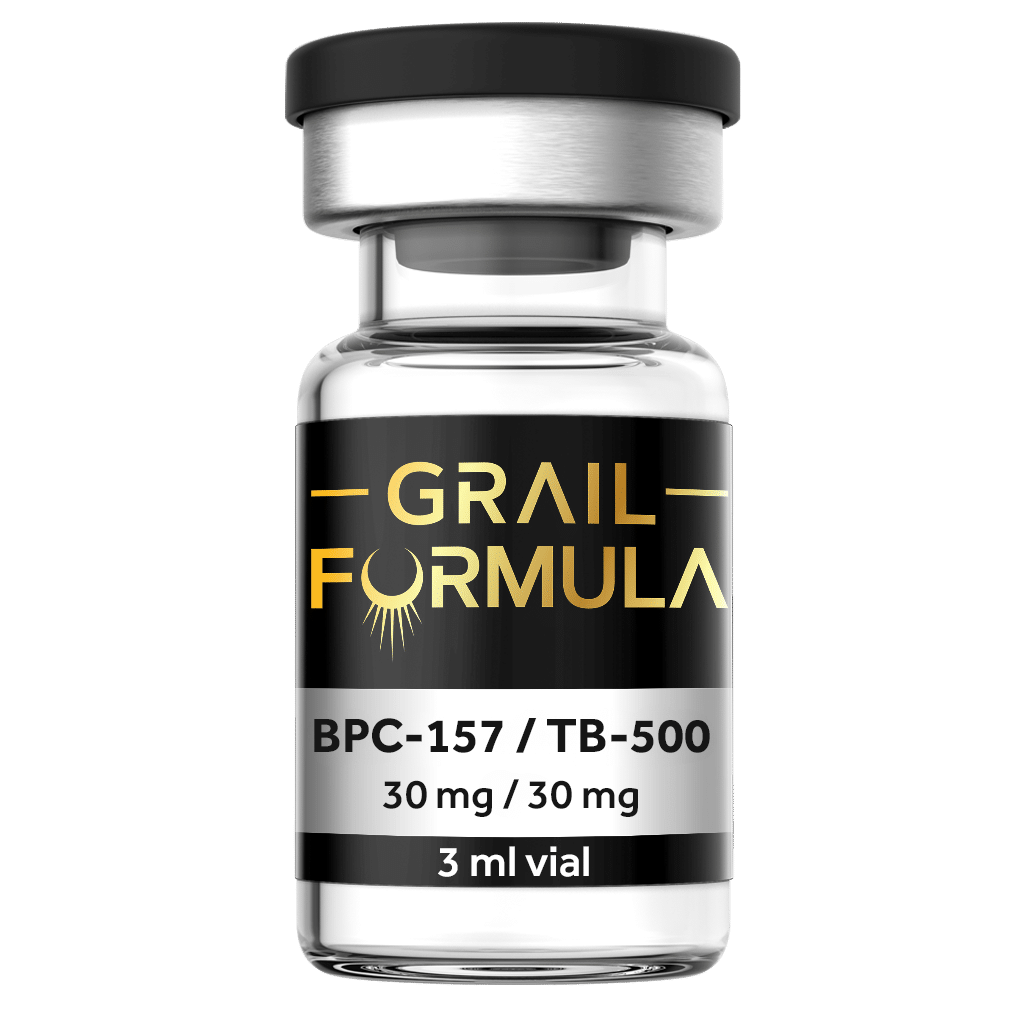
BPC-157 / TB-500 30 mg / 30 mg – Grail Formula Quality.
Researched and verified with Liquilabs s.r.o. Czechia.
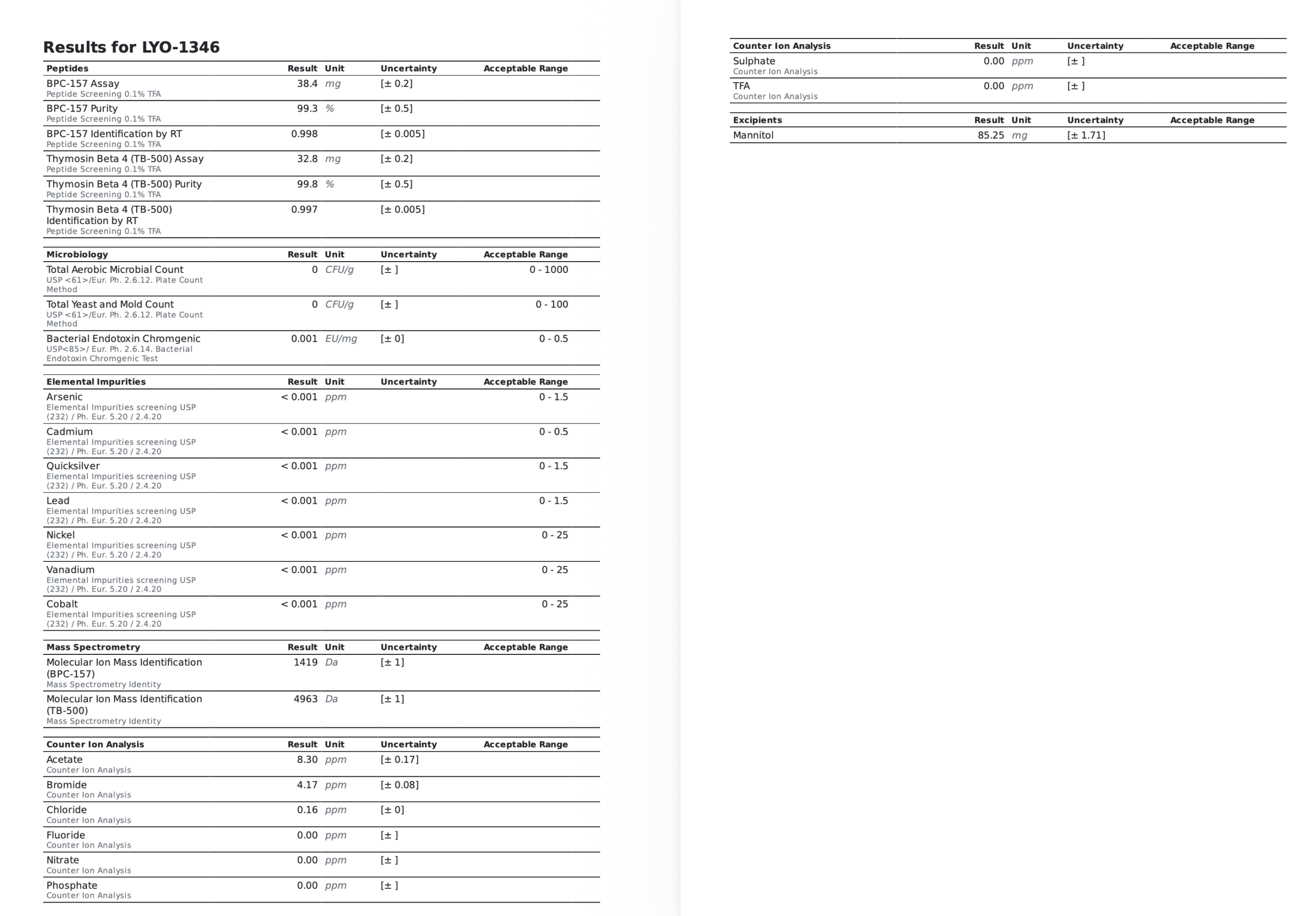
Analytical testing reports 99.3% BPC-157 purity and 99.8% TB-500 purity, assay contents measured at 38.4 mg and 32.8 mg, molecular ion masses identified at 1419 Da and 4963 Da, and bacterial endotoxin measured at 0.001 EU/mg.
Supplied as a nominal 30 mg / 30 mg lyophilized dual-peptide research preparation with full batch-specific COA traceability, including counter ion and mannitol analysis.
For research use only — not for human or veterinary use.
Availability: In stock: ships within 1 day after payment confirmation.
Volume Discounts – the more you order, the more you save
5%
DISCOUNT
SPEND
€ 250+
10%
DISCOUNT
SPEND
€ 500+
15%
DISCOUNT
SPEND
€ 1.000+
20%
DISCOUNT
SPEND
€ 2.000+
25%
DISCOUNT
SPEND
€ 4.000+
Applied automatically at checkout based on your total cart value.
 | Secure Transaction |
BPC-157 / TB-500 30 mg / 30 mg is a lyophilized dual-peptide research preparation supplied by Grail Formula exclusively for scientific research and controlled in vitro laboratory experimentation. The combination is relevant to investigations involving peptide chemistry, molecular interactions, cytoskeletal organisation and intracellular signalling mechanisms.
For research use only — not for human or veterinary use.
Product Overview
This research preparation combines BPC-157 and TB-500 (Thymosin Beta-4), with a nominal peptide content of 30 mg per compound.
Independent analytical testing performed by Liquilabs s.r.o. Czechia reported a chromatographic purity of 99.3 ± 0.5% for BPC-157 and 99.8 ± 0.5% for TB-500. Measured assay contents were 38.4 ± 0.2 mg and 32.8 ± 0.2 mg, respectively.
Peptide Overview
BPC-157 is a synthetic pentadecapeptide consisting of 15 amino acid residues, investigated within experimental peptide chemistry, molecular biology and cellular signalling research.
TB-500, identified as Thymosin Beta-4 in the analytical results, corresponds to a 43-amino-acid peptide associated with G-actin binding and cytoskeletal organisation.
The distinct molecular structures of both peptides provide a basis for comparative laboratory investigations involving peptide characterisation and molecular interactions.
Historical Background and Scientific Context
BPC-157 has been investigated within experimental molecular biology since the 1990s, with research focusing on peptide-associated biochemical pathways and cellular mechanisms.
Thymosin Beta-4 was identified through investigations into thymosin peptide fractions and subsequently studied in relation to actin-binding mechanisms and intracellular organisation.
Both compounds remain relevant to controlled laboratory investigations involving synthetic peptides and molecular structure–function relationships.
Mechanistic Focus in Research
BPC-157 and Thymosin Beta-4 represent distinct areas of experimental peptide research. Relevant mechanistic investigations include:
- Peptide-associated intracellular signalling pathways
- Nitric oxide-associated molecular mechanisms
- G-actin binding and molecular recognition
- Cytoskeletal organisation and molecular dynamics
- Peptide–protein interactions
- Comparative peptide structure–function relationships
These research areas describe the scientific context of the individual compounds and do not establish functional biological activity, synergistic effects or therapeutic effectiveness for the tested preparation.
Analytical Verification (COA)
Independent laboratory testing was performed by Liquilabs s.r.o. Czechia, with batch-specific analytical results for both peptides.
Batch: GF-BPCTB30-B242
Sample: LYO-1176
COA Publication Date: 10 November 2026
BPC-157 Analysis
- Nominal Peptide Content: 30 mg
- Assay Content: 38.4 ± 0.2 mg
- Purity: 99.3 ± 0.5%
- Retention Time Identification: 0.998 ± 0.005
- Molecular Ion Mass Identification: 1419 ± 1 Da
TB-500 (Thymosin Beta-4) Analysis
- Nominal Peptide Content: 30 mg
- Assay Content: 32.8 ± 0.2 mg
- Purity: 99.8 ± 0.5%
- Retention Time Identification: 0.997 ± 0.005
- Molecular Ion Mass Identification: 4963 ± 1 Da
The combined measured peptide content is 71.2 mg, calculated from the individual assay results.
Microbiological Analysis and Bacterial Endotoxins
- Bacterial Endotoxins: 0.001 EU/mg (reported uncertainty: ±0 EU/mg)
- Total Aerobic Microbial Count: 0 CFU/g
- Total Yeast and Mold Count: 0 CFU/g
All reported microbiological and bacterial endotoxin results fall within the laboratory’s stated acceptance ranges. These results do not establish sterility.
Elemental Impurity Screening
- Arsenic (As): <0.001 ppm
- Cadmium (Cd): <0.001 ppm
- Mercury (Hg): <0.001 ppm
- Lead (Pb): <0.001 ppm
- Nickel (Ni): <0.001 ppm
- Vanadium (V): <0.001 ppm
- Cobalt (Co): <0.001 ppm
Counter Ion Analysis
- Acetate: 8.30 ± 0.17 ppm
- Bromide: 4.17 ± 0.08 ppm
- Chloride: 0.16 ± 0 ppm
- Fluoride: 0.00 ppm
- Nitrate: 0.00 ppm
- Phosphate: 0.00 ppm
- Sulphate: 0.00 ppm
- Trifluoroacetic Acid (TFA): 0.00 ppm
Counter ion analysis provides additional compositional transparency. Values reported at 0.00 ppm should not be interpreted as evidence of absolute absence.
Excipient Analysis
- Mannitol Content: 85.25 ± 1.71 mg
Mannitol is a sugar alcohol commonly used as a bulking excipient in lyophilized preparations. Its measured content is separate from the individual peptide assay results. Chromatographic peptide purity does not represent the percentage of peptide by weight within the complete preparation.
Research Applications
BPC-157 / TB-500 30 mg / 30 mg may be investigated within controlled laboratory environments focusing on:
- Synthetic peptide chemistry and molecular characterisation
- Peptide-associated biochemical pathways
- Actin-binding molecular interactions
- Cytoskeletal organisation and intracellular signalling
- Comparative peptide structure–function studies
- Analytical characterisation of dual-peptide preparations
Grail Formula Quality
Grail Formula emphasises analytical transparency through independent third-party laboratory testing. This dual-peptide preparation is supported by individual assay and purity measurements, molecular identification, microbiological testing, bacterial endotoxin determination, elemental impurity screening, counter ion analysis and quantitative mannitol determination.
When You Choose Grail Formula
Grail Formula provides research peptides supported by independent Certificates of Analysis and batch-specific traceability. Comprehensive analytical documentation supports informed research material selection, compositional transparency and controlled scientific investigation.
Research Use Limitation
Used solely for in vitro experiments and cannot be:
- Used in clinical trials involving humans
- Administered to humans as part of an experiment or investigation
- Supplied to another party for human investigational use.
- Product: BPC-157 / TB-500 30 mg / 30 mg
- Brand: Grail Formula
- Form: Lyophilized dual-peptide research preparation
- Independent Laboratory: Liquilabs s.r.o. Czechia
- Batch Number: GF-BPCTB30-B242
- Sample Identification: LYO-1176
- BPC-157 Assay Content: 38.4 ± 0.2 mg
- BPC-157 Purity: 99.3 ± 0.5%
- BPC-157 Retention Time Identification: 0.998 ± 0.005
- BPC-157 Molecular Ion Mass: 1419 ± 1 Da
- TB-500 Assay Content: 32.8 ± 0.2 mg
- TB-500 Purity: 99.8 ± 0.5%
- TB-500 Retention Time Identification: 0.997 ± 0.005
- TB-500 Molecular Ion Mass: 4963 ± 1 Da
- Combined Measured Peptide Content: 71.2 mg (sum of individual assay results)
- Bacterial Endotoxins: 0.001 EU/mg (reported uncertainty: ±0 EU/mg)
- Total Aerobic Microbial Count: 0 CFU/g
- Total Yeast and Mold Count: 0 CFU/g
- Elemental Impurities: As, Cd, Hg, Pb, Ni, V and Co each <0.001 ppm
- Acetate: 8.30 ± 0.17 ppm
- Bromide: 4.17 ± 0.08 ppm
- Chloride: 0.16 ± 0 ppm
- Fluoride: 0.00 ppm
- Nitrate: 0.00 ppm
- Phosphate: 0.00 ppm
- Sulphate: 0.00 ppm
- Trifluoroacetic Acid (TFA): 0.00 ppm
- Mannitol Content: 85.25 ± 1.71 mg
- COA Publication Date: 10 November 2026
- Research Limitation: For laboratory and in vitro research only; not for human or veterinary use
For laboratory research only. Not intended for human consumption, injection, or cosmetic use.
This product is for research purposes only. Not for human use or diagnostic/therapeutic applications. Keep out of reach of children.
Third-Party Tested
Public COAs
Batch Verified
EU Shipping
Related Products

€ 49,00 Original price was: € 49,00.€ 44,00Current price is: € 44,00.
€ 79,00 Original price was: € 79,00.€ 69,00Current price is: € 69,00.