
ahk-cu
If you want to buy AHK-Cu for research purposes, you will find here a category for direct comparison by specification rather than just by product name. Researchers and quality-focused buyers can review available AHK-Cu options by purity, independently verified batch-specific COAs, product form, and handling. This lets you purchase based on data and, if needed, find on the same website suitable additions such as bacteriostatic water as well as background information on copper peptide research, reconstitution, and storage.
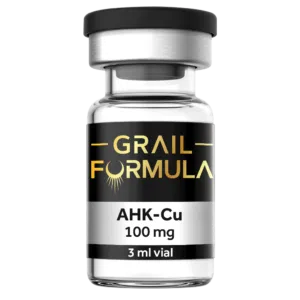

AHK-Cu is a copper peptide used in fundamental research as a study subject. Purity and verifiable provenance are essential for scientific use; each batch is supplied with a Certificate of Analysis. For research and laboratory use only.
Category: Research peptides
Buying AHK-Cu: The quality data you should check before ordering
Before you order AHK-Cu, at least these points should be clearly visible on the product page:
- Purity, peptide identity, and batch-specific documentation via lab-tested COAs; where provided, HPLC data make direct offer comparison easier.
- Clear molecular details such as sequence, product form, and specification, so you buy not just by name but by identity.
- Information on lyophilized format, solubility, reconstitution, and shelf life, because these criteria affect subsequent handling in the lab.
AHK-Cu and GHK-Cu compared
| Feature | AHK-Cu | GHK-Cu |
|---|---|---|
| Peptide identity | Ala-His-Lys as a copper-bound tripeptide | Gly-His-Lys as a copper-bound tripeptide |
| Common comparison context | When literature or procurement explicitly mentions AHK-Cu | When copper peptides are compared more generally or by sequence |
| Typical research focus | Often discussed in hair follicle- and scalp-related questions | Often compared in broader matrix and copper peptide contexts |
| For your selection | Right if the project goal and identity are clearly oriented toward AHK-Cu | Review separately if you want to contrast alternatives within copper peptides |
Research focuses often associated with AHK-Cu
In the literature, AHK-Cu is often linked to hair follicle biology, vascular processes in the scalp context, and the dermal matrix. In product comparisons with the GHK‑Cu peptide, questions about hair growth, hair density, hair diameter, and the anagen phase regularly arise. Collagen, elastin, and regeneration contexts are also mentioned. For purchasing, what matters is which research focus actually takes precedence in your protocol.
Which signaling pathways are often mentioned in AHK-Cu research
In mechanistic framing, these axes are often mentioned:
- VEGF-related signaling and angiogenesis-adjacent processes.
- Links to the anagen phase as well as to dermal papilla-related questions.
- Copper-dependent enzymes and cofactor relationships, for example around Lysyl-Oxidase and matrix remodeling.
- Collagen, fibroblast, and connective tissue contexts as part of the research framework.
Reconstitution and storage in the lab
For lab handling, it matters in which form AHK-Cu is delivered and how your protocol provides for the work-up:
- Lyophilized material is reconstituted with sterile or bacteriostatic water depending on product and protocol specifications.
- Unopened lyophilized material and already reconstituted solutions have different storage requirements.
- Cooling is often relevant; possible freezer storage and stability after preparation should always be checked per product.
- After mixing, plan for clean, swift handling with minimal light and oxidation exposure.
Shipping and note on research use
Always check availability, delivery status, and batch-specific documents directly on the respective product page. 24Peptides ships from a European warehouse; relevant transport notes are listed there by product, and replacement is provided for lost or damaged shipments. For clarity on the legal framework when purchasing and importing in Germany, read the notes under Peptides in Germany: legal framework. Important: AHK-Cu is for research purposes only, not for human use, and only for purchasers aged 18 and over.
Select suitable AHK-Cu products now
Now compare the available AHK-Cu products by specification, batch data, COA, and current availability. If you are planning reconstitution or handling, also check on the same website bacteriostatic water as well as further information on COA, storage, and product data. Then choose the appropriate product option, add it to the cart, and complete your order.