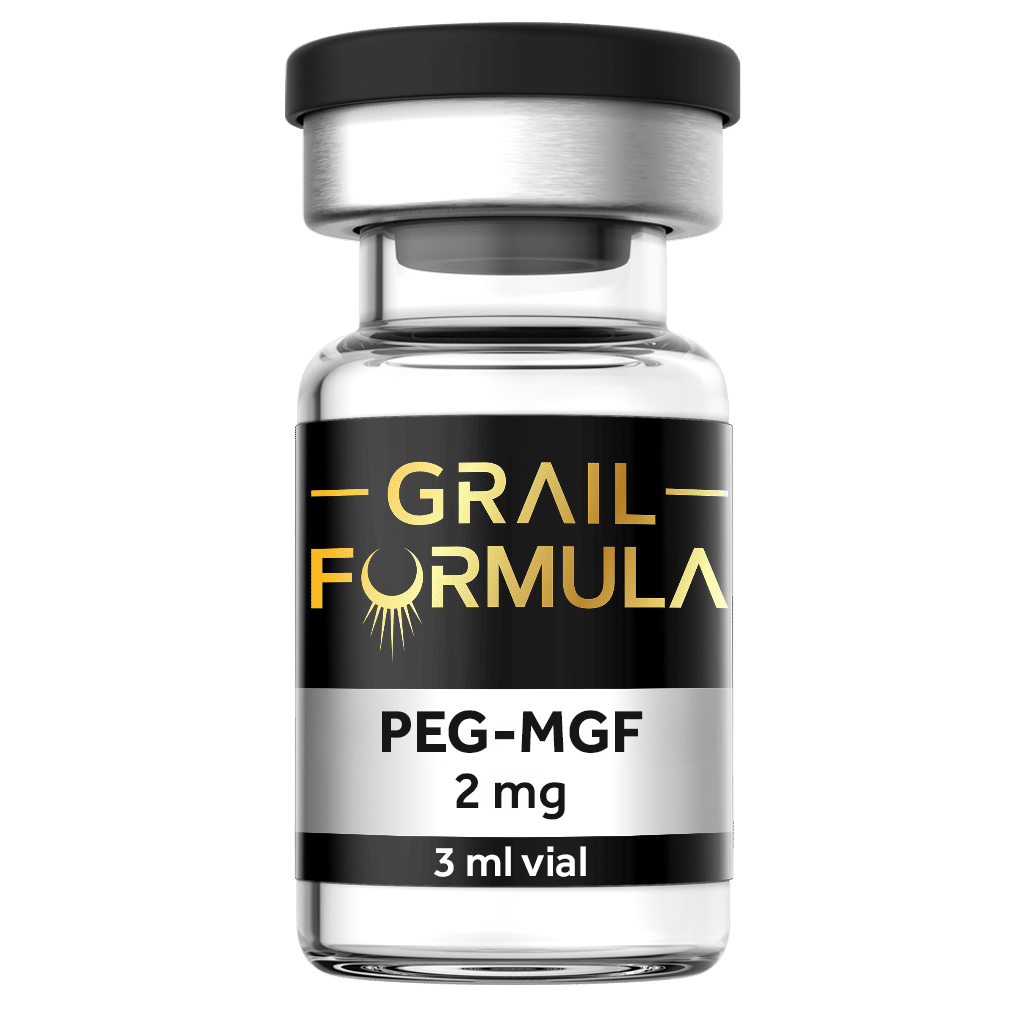
PEG-MGF 2mg
€ 64,00
Grail Formula Quality
PEG-MGF 2 mg – IGF Pathway Research Peptide.
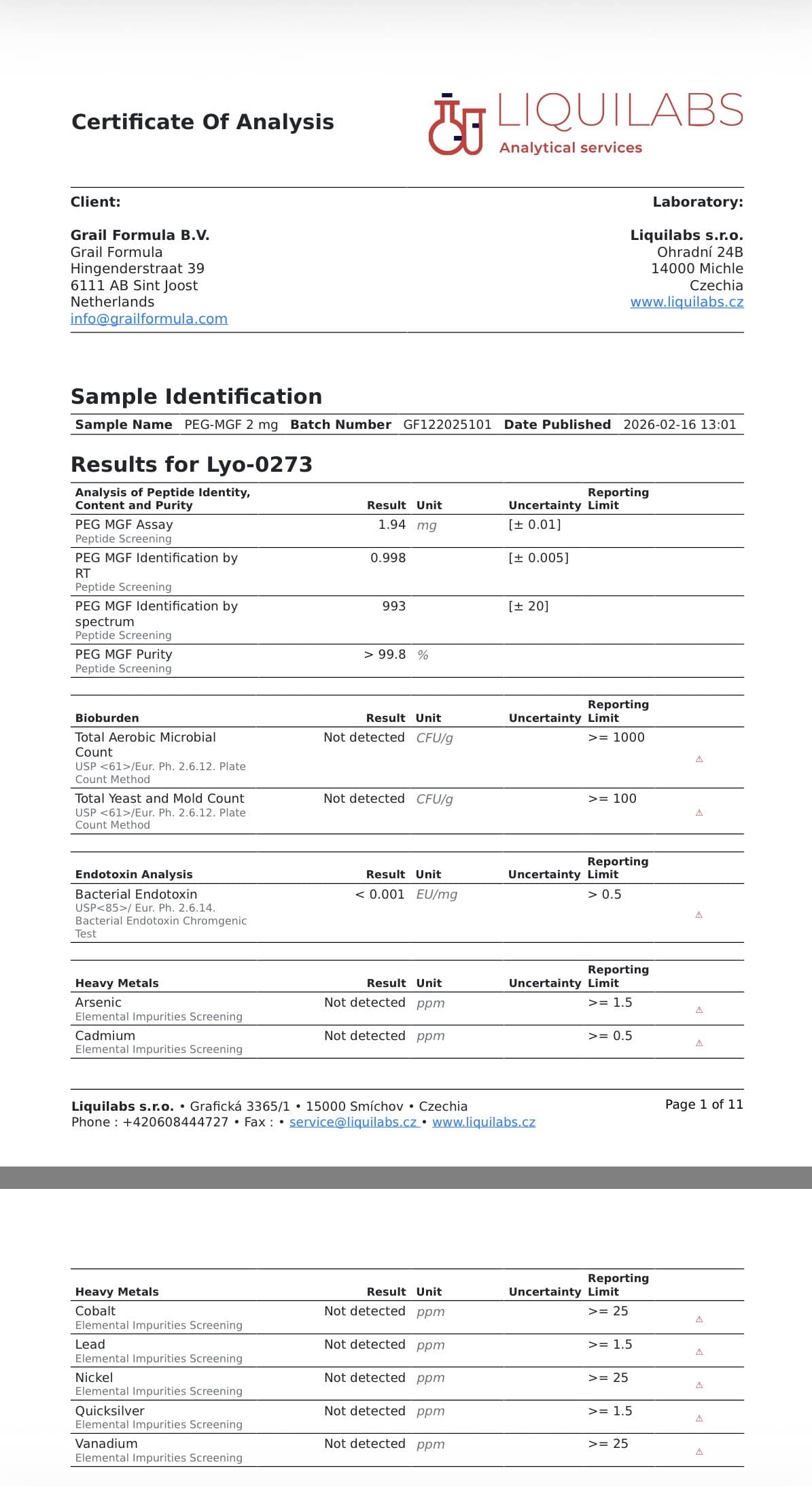
Independently analysed by Liquilabs s.r.o. (Czechia).
Validated assay content: 1.94 mg with purity greater than 99.8 percent.
Endotoxin levels below 0.001 EU per mg. No detectable microbial growth or heavy metals.
For research use only — not for human or veterinary use.
Availability: In stock: ships within 1 day after payment confirmation.
For research use only — not for human or veterinary use.
Analytical Verification (COA)
Each batch of PEG-MGF supplied by Grail Formula undergoes independent third-party laboratory verification to confirm compound identity, assay content, purity and microbiological safety.
Analytical testing for this batch was performed by Liquilabs s.r.o. (Czechia) using validated chromatographic and spectrometric techniques.
Batch: GF122025101
Key analytical results include:
- Assay Content: 1.94 mg
- Identification – Retention Time: 0.998
- Identification – Spectrum: 993
- Purity: greater than 99.8 percent
- Bacterial Endotoxins: below 0.001 EU per mg
- Total Aerobic Microbial Count: not detected
- Total Yeast and Mold Count: not detected
Independent heavy metal screening confirmed no detectable levels of arsenic, cadmium, cobalt, lead, nickel, mercury or vanadium.
These analytical procedures ensure traceability, purity verification and laboratory-grade compound consistency.
Product Overview
PEG-MGF (Pegylated Mechano Growth Factor) is a synthetic peptide research compound frequently studied in controlled laboratory environments examining peptide-mediated signalling pathways and muscle-related cellular processes.
The compound is a pegylated analogue of mechano growth factor (MGF), a splice variant of insulin-like growth factor-1 (IGF-1) that has been investigated in experimental research exploring tissue signalling and regenerative molecular pathways.
This preparation contains 2 mg of high purity lyophilized peptide supplied in a sealed research vial. The lyophilization process preserves peptide stability and allows researchers to reconstitute the compound for controlled in vitro experimentation.
Because of its defined peptide structure and stable analytical profile, PEG-MGF has become a commonly referenced compound in experimental peptide signalling and tissue-response research models.
Compound Overview
PEG-MGF, or Pegylated Mechano Growth Factor, is a modified peptide derived from a naturally occurring splice variant of insulin-like growth factor-1 (IGF-1).
The MGF variant is produced within muscle tissue in response to mechanical stress and has been studied in laboratory models investigating cellular signalling related to tissue adaptation.
Pegylation is a chemical modification that attaches polyethylene glycol (PEG) chains to the peptide molecule, a process commonly used in biochemical research to influence molecular stability and experimental pharmacokinetic properties.
Due to these characteristics, PEG-MGF is used in controlled experimental models examining peptide signalling, receptor interaction pathways and cellular regulatory mechanisms.
Historical Background and Scientific Context
Scientific interest in insulin-like growth factor signalling systems expanded significantly during the late twentieth century as researchers began mapping complex cellular growth and regulatory pathways.
During the 1990s researchers identified mechano growth factor (MGF) as a splice variant of IGF-1 expressed in muscle tissue following mechanical stimulation.
Subsequent biochemical research explored how synthetic analogues of MGF could be used to study cellular signalling pathways associated with tissue response and molecular regulation.
In later experimental work, pegylated versions such as PEG-MGF were developed to provide greater stability for controlled laboratory experimentation.
Mechanistic Focus in Research
Within experimental laboratory settings, PEG-MGF is frequently studied in relation to peptide-mediated signalling pathways and cellular response mechanisms.
Research investigations commonly explore the compound in experimental models examining:
- IGF-1 related signalling pathways
- Peptide-receptor interaction dynamics
- Cellular response to mechanical signalling models
- Tissue signalling pathway regulation
- Molecular peptide stability research
- Comparative peptide signalling analysis
- Intracellular regulatory pathway modelling
These experimental models allow scientists to investigate molecular signalling mechanisms that influence cellular communication and biochemical regulatory processes.
Research Applications
In controlled research environments, PEG-MGF may be utilised in experimental models designed to explore peptide signalling and tissue-response regulatory pathways.
Examples of research applications include:
- Peptide signalling pathway investigation
- IGF-related cellular pathway studies
- Receptor interaction analysis
- Molecular peptide research
- Comparative peptide compound evaluation
- Intracellular regulatory network modelling
- Controlled in vitro peptide studies
Grail Formula Quality
Every Grail Formula research compound is produced under strict quality control procedures designed to support reliable laboratory experimentation.
Each batch undergoes independent analytical testing to verify:
- Compound identity
- Assay accuracy
- Purity confirmation
- Microbial safety
- Endotoxin levels
- Heavy metal screening
- Full batch traceability
All testing is performed by independent laboratories to ensure transparent verification and reproducible research material.
Research Use Limitation
- Used solely for in vitro experiments
- Not permitted for clinical trials involving humans
- Not permitted for human or veterinary administration
- Not permitted for investigational human use
Independently verified by Liquilabs s.r.o. (Czechia)
Validated assay content 1.94 mg
Purity greater than 99.8 percent
Retention time and spectral identity confirmation
Endotoxin levels below 0.001 EU per mg
No detectable microbial contamination
No detectable heavy metals
For research use only — not for human or veterinary use
For laboratory research only. Not intended for human consumption, injection, or cosmetic use.
This product is for research purposes only. Not for human use or diagnostic/therapeutic applications. Keep out of reach of children.