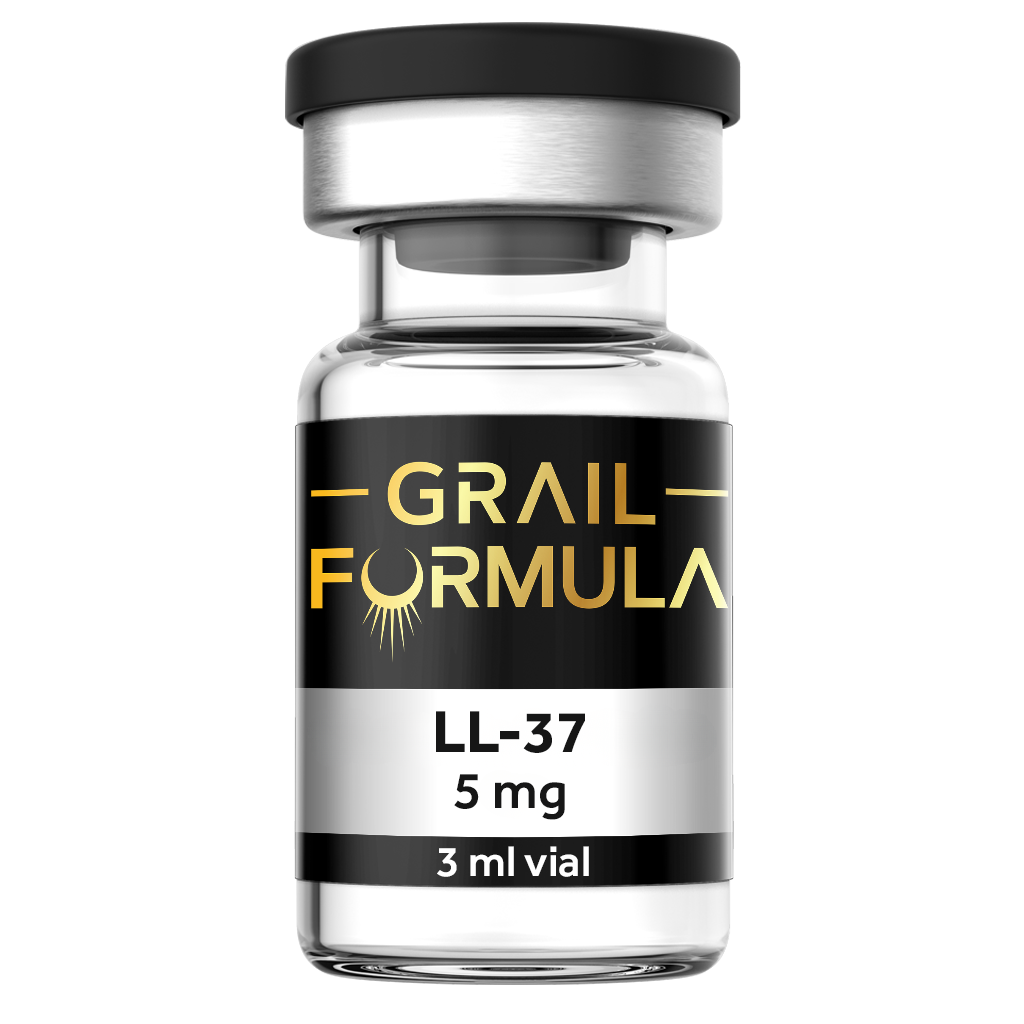

LL-37 5mg
€ 59,00 Original price was: € 59,00.€ 54,00Current price is: € 54,00.
LL-37 5 mg – Grail Formula Quality.
Researched and verified with Liquilabs s.r.o. Czechia.
Analytical testing confirms greater than 99.8 % purity, assay content measured at 7.12 mg, molecular ion mass identified at 4493 Da and bacterial endotoxin measured at 0.012 EU/mg.
Supplied as a nominal 5 mg peptide research preparation with full COA traceability.
For research use only — not for human or veterinary use.
Availability: In stock: ships within 1 day after payment confirmation.
Volume Discounts – the more you order, the more you save
5%
DISCOUNT
SPEND
€ 250+
10%
DISCOUNT
SPEND
€ 500+
15%
DISCOUNT
SPEND
€ 1.000+
20%
DISCOUNT
SPEND
€ 2.000+
25%
DISCOUNT
SPEND
€ 4.000+
Applied automatically at checkout based on your total cart value.
 | Secure Transaction |
LL-37 5 mg is a high-purity peptide research compound supplied by Grail Formula for scientific investigation and controlled laboratory experimentation involving innate immune signalling, antimicrobial peptide biology and cellular defence mechanisms.
For research use only — not for human or veterinary use.
Product Overview
LL-37 is a human cathelicidin-derived peptide investigated in experimental research involving innate immunity, antimicrobial defence, host-pathogen interactions and cellular signalling. Its biological origin and amphipathic molecular structure have attracted scientific interest in the mechanisms through which naturally occurring peptides interact with microbial membranes and host cells.
Grail Formula supplies LL-37 5 mg as a nominal 5 mg peptide research preparation intended for qualified laboratory researchers examining peptide-mediated defence mechanisms and molecular interactions under controlled experimental conditions.
Independent analytical testing was conducted by Liquilabs s.r.o., Czechia. The Certificate of Analysis, published on 11 October 2026, identifies production batch GF-LL375-B242 and reports a measured assay content of 7.12 mg with chromatographic purity of greater than 99.8 %.
The measured assay content exceeds the nominal 5 mg designation by 2.12 mg, corresponding to a 42.4 % difference. This substantial positive assay deviation is disclosed separately from the chromatographic purity measurement.
The reported purity describes the chromatographic composition under the applied analytical conditions. It must not be interpreted as confirmation of a particular milligram quantity or as evidence of biological safety.
Peptide Overview
LL-37 is a naturally occurring human antimicrobial peptide consisting of 37 amino acids. It is derived from the C-terminal region of the human cathelicidin precursor protein hCAP18, encoded by the CAMP gene.
The peptide belongs to the cathelicidin family, a group of host defence peptides investigated for their involvement in innate immune responses and interactions between host tissues and microorganisms.
LL-37 has a predominantly alpha-helical, amphipathic structure under suitable experimental conditions. This arrangement of hydrophobic and positively charged regions contributes to its scientific relevance in studies of peptide-membrane interactions.
Researchers have investigated LL-37 in connection with bacterial membrane disruption, microbial biofilm models, immune-cell signalling and inflammatory regulatory pathways.
Its biological activity is complex and depends on experimental conditions, including peptide concentration, ionic environment, membrane composition and the cellular or microbial model employed.
In addition to its antimicrobial properties observed in experimental systems, LL-37 has attracted research attention because of its reported interactions with host-cell receptors and intracellular signalling mechanisms.
These findings make LL-37 relevant to laboratory investigations examining the relationship between antimicrobial peptides, innate immune regulation and cellular communication.
Historical Background and Scientific Context
Scientific research into antimicrobial peptides expanded considerably during the twentieth century as investigators identified naturally occurring molecules involved in the defence mechanisms of diverse organisms.
Cathelicidins emerged as an important group of host defence peptides characterised by conserved precursor regions and variable biologically active peptide domains.
Human LL-37 was identified during research into the processing and biological functions of the hCAP18 cathelicidin precursor. The peptide’s name reflects its 37-amino-acid sequence and the presence of two leucine residues at its N-terminus.
Early investigations focused on antimicrobial activity and interactions with microbial membranes. Subsequent studies expanded into immune signalling, chemotaxis, inflammatory responses and host-cell communication.
Advances in structural biology and analytical chemistry enabled researchers to examine the relationship between LL-37’s molecular organisation and its interactions with biological membranes.
Research has also explored the presence and regulation of cathelicidin-derived peptides in different tissue environments and experimental models of innate immunity.
More recent investigations have examined LL-37 in relation to microbial biofilms, extracellular nucleic acids, immune-cell activation and the regulation of inflammatory signalling.
These observations demonstrate the broad scientific interest surrounding LL-37 while also highlighting the context-dependent nature of its reported biological effects.
Experimental findings should not be interpreted as establishing clinical efficacy, safety or suitability for administration of a particular laboratory research preparation.
Mechanistic Focus in Research
One prominent area of LL-37 research concerns its interaction with biological membranes. The peptide’s cationic and amphipathic characteristics have been investigated in experimental models involving negatively charged microbial membrane components.
Researchers examine how peptide structure, membrane composition and environmental conditions influence binding, membrane organisation and permeability.
Antimicrobial peptide and membrane research
Experimental studies have investigated LL-37-associated membrane disruption and interactions with bacterial lipid structures. These investigations contribute to the broader understanding of host defence peptide mechanisms.
The magnitude and nature of observed effects vary according to the microbial species, peptide concentration, ionic conditions and experimental methodology.
Innate immune signalling
LL-37 has also been studied in relation to immune-cell communication and the regulation of inflammatory signalling pathways.
Scientific investigations have explored interactions involving formyl peptide receptor 2 (FPR2), as well as other cellular signalling systems associated with immune responses.
These receptor-related observations remain dependent on the experimental model and should not be interpreted as universal biological effects.
Extracellular nucleic acid interactions
Another research area concerns the ability of LL-37 to interact with extracellular DNA and RNA under certain experimental conditions.
Such interactions have been investigated in relation to nucleic acid organisation, cellular uptake and immune recognition pathways.
Biofilm and host-pathogen investigations
LL-37 is also examined in experimental microbial biofilm models, where researchers study peptide interactions with microbial communities and extracellular matrix components.
These studies contribute to understanding antimicrobial peptide behaviour in complex biological environments.
The supplied Certificate of Analysis documents chemical and microbiological characteristics of the tested material. It does not contain biological activity assays demonstrating antimicrobial efficacy, receptor activation or a particular cellular response.
Analytical Verification (COA)
Grail Formula supports batch-specific analytical transparency through independent third-party laboratory testing. The LL-37 5 mg Certificate of Analysis was issued by Liquilabs s.r.o., Czechia, with a publication date of 11 October 2026.
The report identifies the sample as LL-37 5 mg, batch GF-LL375-B242, and provides analytical results for peptide assay content, chromatographic purity, identity assessment, microbiological counts, bacterial endotoxins and elemental impurities.
Peptide assay and chromatographic purity
- Nominal product quantity: 5 mg
- Measured LL-37 assay content: 7.12 mg ± 0.04 mg
- Reported LL-37 purity: greater than 99.8 %
- Measured assay difference from nominal quantity: 2.12 mg above the labelled 5 mg
- Peptide analysis designation: Peptide Screening 0.1% TFA
The measured assay content corresponds to 142.4 % of the nominal 5 mg quantity. This is a substantial positive assay deviation and should be considered when interpreting the analytical characteristics of the tested sample.
The reported chromatographic purity of greater than 99.8 % is a separate analytical result. It does not represent the percentage of the nominal vial quantity recovered in the assay.
Peptide identity assessment
- FTIR spectrum identification result: 948 ± 5, as reported
- Retention time identification result: 0.997 ± 0.005, as reported
- Molecular ion mass identification: 4493 Da ± 1 Da
- Mass spectrometry identity assessment: MS deconvolution
The Certificate of Analysis includes chromatographic and mass spectrometric documentation supporting the analytical characterisation of the tested sample.
The FTIR and retention time values are reproduced as reported. The summary does not provide explicit pass/fail interpretations for these identification measurements.
Bacterial endotoxin and microbiological assessment
- Bacterial endotoxin: 0.012 EU/mg
- Reported endotoxin acceptable range: 0–0.5 EU/mg
- Total aerobic microbial count: 0 CFU/g
- Total yeast and mould count: 0 CFU/g
- Reported aerobic microbial count range: 0–1000 CFU/g
- Reported yeast and mould count range: 0–100 CFU/g
Microbiological testing references USP <61> / European Pharmacopoeia 2.6.12 plate-count methodology. Bacterial endotoxin determination references USP <85> / European Pharmacopoeia 2.6.14 chromogenic testing.
Both microbiological counts were reported as zero under the applied testing conditions. Bacterial endotoxin was measurable at 0.012 EU/mg, within the laboratory’s stated acceptable range.
These results describe the tested sample and do not establish sterility or suitability for biological administration.
Elemental impurity screening
Seven elemental impurities were evaluated using screening procedures referenced to USP <232> and European Pharmacopoeia 5.20 / 2.4.20.
- Arsenic: below 0.001 ppm
- Cadmium: below 0.001 ppm
- Mercury (listed as quicksilver): below 0.001 ppm
- Lead: below 0.001 ppm
- Nickel: below 0.001 ppm
- Vanadium: below 0.001 ppm
- Cobalt: below 0.001 ppm
All seven reported elemental impurity results were below 0.001 ppm and within their respective stated acceptable ranges.
Results below the analytical reporting threshold indicate concentrations below the specified level rather than proof of absolute absence.
The complete 13-page Certificate of Analysis contains supporting chromatographic documentation, mass spectrometric records, endotoxin determination information and microbiological methodology descriptions.
Research Applications
LL-37 is investigated across several areas of experimental peptide biology, microbiology and innate immune research. Its relevance arises from its naturally occurring role as a cathelicidin-derived host defence peptide and its reported interactions with microbial and cellular systems.
Potential areas of laboratory investigation include:
- Antimicrobial peptide structure and membrane interactions
- Innate immune signalling and host defence peptide biology
- Experimental host-pathogen interaction models
- Microbial membrane permeability and lipid interaction studies
- Biofilm-associated peptide research
- Immune-cell communication and receptor-associated signalling
- Extracellular nucleic acid and peptide interaction studies
- Analytical peptide characterisation and comparative laboratory investigations
These applications represent scientific research areas rather than established therapeutic uses. Individual experiments require appropriate controls, validated measurement endpoints and careful interpretation of results.
Batch-specific analytical documentation can support laboratory recordkeeping and assist researchers in evaluating the reported characteristics of the tested preparation.
Grail Formula Quality
Grail Formula focuses on supplying laboratory research compounds supported by transparent product information and independently documented analytical findings.
For LL-37 5 mg, independent Liquilabs testing provides measured information concerning peptide assay content, chromatographic purity, analytical identity, bacterial endotoxin levels, microbiological counts and selected elemental impurities.
Each result should be interpreted within the scope of the tested sample, the applied analytical methodology and the reported measurement uncertainty.
By presenting the measured 7.12 mg assay content alongside the nominal 5 mg product designation, Grail Formula maintains a clear distinction between labelled quantity and independent laboratory findings.
When You Choose Grail Formula
Choosing Grail Formula means selecting a research compound accompanied by independently documented, batch-specific analytical information rather than relying solely on general product specifications.
For this LL-37 preparation, researchers can review the Liquilabs Certificate of Analysis to examine the reported purity, measured peptide content, identity assessment, microbiological findings and elemental impurity screening.
The report provides a defined batch reference and publication date, allowing the analytical findings to be associated with the identified production batch.
Grail Formula emphasises factual product presentation, research-oriented documentation and transparent reporting of analytical results, including differences between nominal and measured quantities.
Research Use Limitation
- Used solely for laboratory and in vitro research
- Not approved for human consumption
- Not approved for veterinary use
- Not intended for diagnostic purposes
- Not intended for therapeutic applications
- Not permitted for clinical administration
- For research use only
- Independently analysed by Liquilabs s.r.o. Czechia
- LL-37 purity: greater than 99.8 % reported by COA
- Assay content measured at 7.12 mg against a nominal 5 mg
- Identification evaluated by FTIR spectrum and retention time analysis
- Molecular ion mass identified at 4493 Da
- Bacterial endotoxin level of 0.012 EU/mg
- Total aerobic microbial count: 0 CFU/g
- Total yeast and mould count: 0 CFU/g
- All seven reported elemental impurities below 0.001 ppm
- Batch number: GF-LL375-B242
- COA publication date: 11 October 2026
- Complete batch-specific COA traceability
- Cathelicidin-derived peptide for antimicrobial and innate immune research
- For research use only – not for human or veterinary use
For laboratory research only. Not intended for human consumption, injection, or cosmetic use.
This product is for research purposes only. Not for human use or diagnostic/therapeutic applications. Keep out of reach of children.
Third-Party Tested
Public COAs
Batch Verified
EU Shipping
Related Products

€ 79,00 Original price was: € 79,00.€ 69,00Current price is: € 69,00.