
PE-22-28 10mg
€ 59,00 Original price was: € 59,00.€ 54,00Current price is: € 54,00.
PE-22-28 10 mg – Grail Formula Quality.
Researched and independently verified by Liquilabs s.r.o. Czechia.
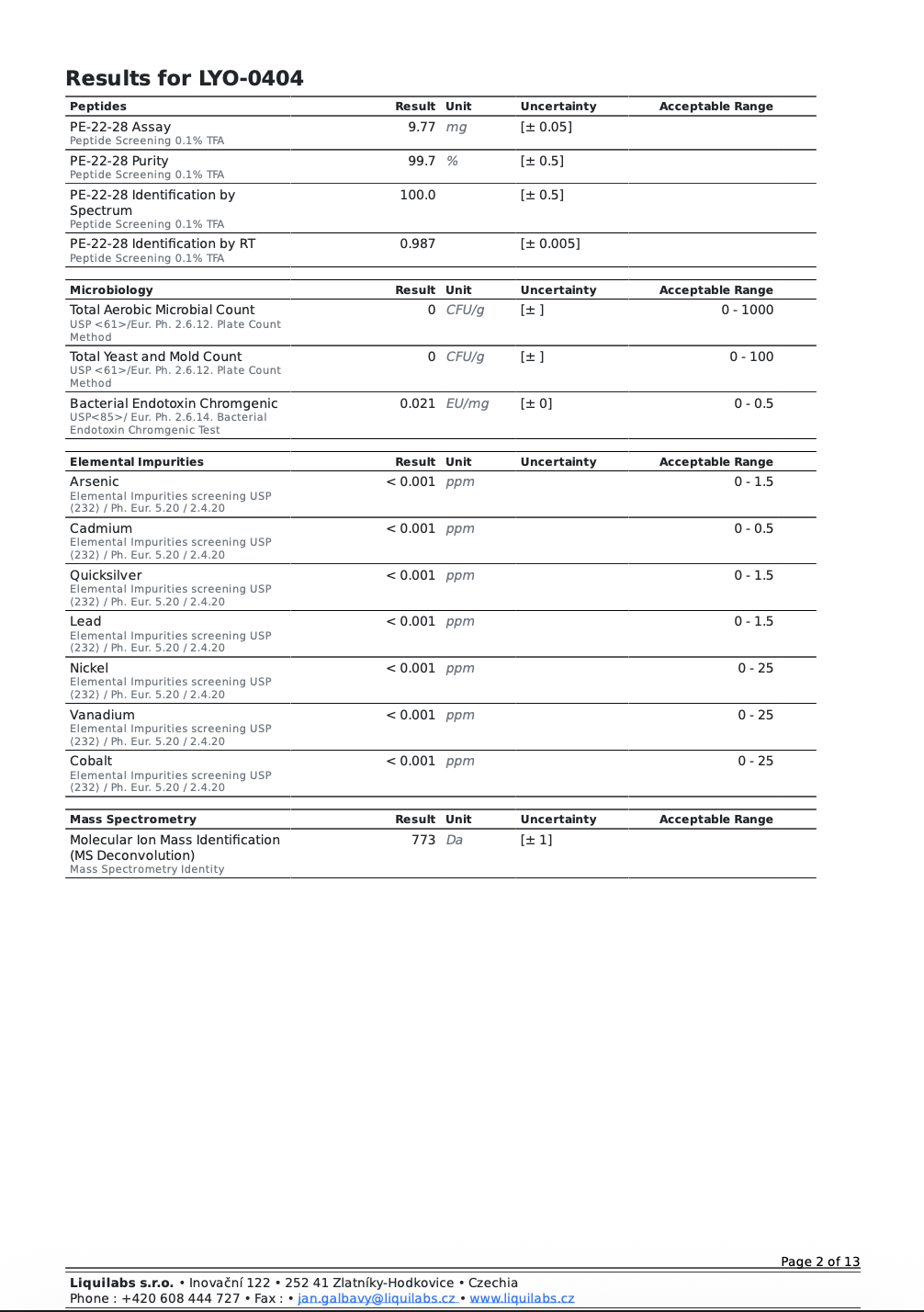
Analytical testing confirms 99.7 % purity, with assay content verified at 9.77 mg. Identity was confirmed through spectrum analysis, HPLC retention time verification and mass spectrometry, with a molecular ion mass identified at 773 Da.
Bacterial endotoxin levels measured 0.021 EU/mg, with no detectable aerobic microorganisms, yeast or mold in the tested sample.
Supplied as a 10 mg lyophilized peptide research compound with full batch-specific COA traceability.
For research use only — not for human or veterinary use.
Availability: In stock: ships within 1 day after payment confirmation.
Volume Discounts – the more you order, the more you save
5%
DISCOUNT
SPEND
€ 250+
10%
DISCOUNT
SPEND
€ 500+
15%
DISCOUNT
SPEND
€ 1.000+
20%
DISCOUNT
SPEND
€ 2.000+
25%
DISCOUNT
SPEND
€ 4.000+
Applied automatically at checkout based on your total cart value.
 | Secure Transaction |
PE-22-28 10 mg is a high-purity lyophilized peptide research compound supplied exclusively for scientific investigation and controlled laboratory experimentation.
For research use only — not for human or veterinary use.
Product Overview
PE-22-28 is a synthetic peptide research compound manufactured for controlled scientific investigations involving peptide chemistry, molecular interactions and experimental biochemical systems.
This preparation contains 10 mg of lyophilized PE-22-28 supplied in a sealed research vial. Independent third-party analytical testing of this production batch measured an assay content of 9.77 mg and chromatographic purity of 99.7 percent.
The analytical identity of the tested material was evaluated using multiple complementary techniques. Spectrum identification produced a result of 100.0, HPLC retention time identification measured 0.987 and mass spectrometry identified a molecular ion mass of 773 Da.
In addition to peptide identity, assay and purity testing, this production batch underwent bacterial endotoxin analysis, microbiological testing and elemental impurity screening, providing researchers with a comprehensive batch-specific analytical profile.
With its independently verified analytical characteristics and complete third-party Certificate of Analysis documentation, PE-22-28 provides a highly characterised research material for controlled laboratory investigations.
Peptide Overview
PE-22-28 belongs to the expanding category of synthetic peptide compounds investigated within modern peptide science and experimental molecular research.
Research peptides such as PE-22-28 allow investigators to study defined molecular structures and peptide-associated biochemical interactions within carefully controlled experimental environments.
The value of a research peptide depends not only on its stated identity but also on the analytical characterisation of the individual production batch. Parameters including assay content, chromatographic purity, identity verification and molecular mass provide important information regarding the characteristics of the tested material.
For this reason, PE-22-28 is supported by independent laboratory analysis covering multiple analytical parameters rather than relying solely on a stated purity percentage.
Scientific and Research Context
Advances in peptide synthesis and analytical chemistry have enabled increasingly detailed investigation of synthetic peptide compounds under controlled laboratory conditions.
Modern analytical techniques allow researchers to evaluate research peptides through multiple independent measurements. Chromatographic methods can determine assay content and purity, while spectrum analysis, retention time comparison and mass spectrometry provide additional information supporting compound identification.
Microbiological analysis, bacterial endotoxin testing and elemental impurity screening further expand the analytical profile by examining characteristics beyond peptide concentration and chromatographic purity.
This multi-parameter approach is particularly valuable within research environments where batch consistency, traceability and transparent analytical documentation are important considerations.
Mechanistic Focus in Research
Within controlled laboratory environments, PE-22-28 may be used as an investigational peptide compound in experimental models involving peptide chemistry, molecular interactions and biochemical signalling systems.
Research areas may include:
- Peptide chemistry investigations
- Molecular interaction studies
- Peptide-associated signalling research
- Cellular pathway investigations
- Biochemical regulatory research
- Comparative peptide analysis
- Molecular biology investigations
- Controlled in vitro peptide experimentation
These areas describe laboratory research contexts only and do not imply established therapeutic, diagnostic or clinical applications.
Analytical Verification (COA)
This production batch of PE-22-28 underwent independent third-party analysis by Liquilabs s.r.o. Czechia. The Certificate of Analysis provides batch-specific information covering assay content, purity, identity, molecular ion mass, microbiological quality, bacterial endotoxin levels and elemental impurities.
Batch: GF-PE2228-B242
- Labelled Content: 10 mg
- Assay Content: 9.77 mg
- Purity: 99.7 percent
- Identification by Spectrum: 100.0
- Identification by Retention Time: 0.987
- Molecular Ion Mass Identification: 773 Da
- Bacterial Endotoxins: 0.021 EU/mg
- Total Aerobic Microbial Count: 0 CFU/g
- Total Yeast and Mold Count: 0 CFU/g
These results provide several independent analytical parameters for evaluating the tested research material rather than relying on a single measurement.
Assay and Purity Verification
Assay testing determines the measured quantity of the target compound present within the analysed sample. For this PE-22-28 production batch, independent laboratory analysis measured an assay content of 9.77 mg against a labelled content of 10 mg.
Chromatographic purity analysis reported a result of 99.7 percent.
Assay and purity represent different analytical parameters. Assay describes the measured amount of the target compound, whereas chromatographic purity evaluates the relative proportion of the target compound within the detected chromatographic profile.
Reporting both measurements therefore provides researchers with a more informative analytical overview of the individual production batch.
Identity Verification
Compound identity was evaluated using complementary analytical measurements rather than relying exclusively on chromatographic purity.
Spectrum identification produced a reported result of 100.0, while HPLC retention time identification measured 0.987.
Mass spectrometry provided an additional identity parameter, with molecular ion mass identification reported at 773 Da.
The use of multiple analytical techniques provides researchers with several independent data points relating to the identity and analytical characteristics of the tested PE-22-28 sample.
Mass Spectrometry Analysis
Mass spectrometry is an important analytical technique used in peptide research to provide molecular mass information for the material being investigated.
For this PE-22-28 production batch, molecular ion mass identification by MS deconvolution produced a reported result of 773 Da.
This measurement forms part of the broader identity assessment documented within the batch-specific Certificate of Analysis.
Microbiological Testing
Microbiological analysis was performed as an additional component of the independent quality assessment.
The tested batch produced the following results:
- Total Aerobic Microbial Count: 0 CFU/g
- Total Yeast and Mold Count: 0 CFU/g
The Certificate of Analysis states an acceptance range of 0–1000 CFU/g for Total Aerobic Microbial Count and 0–100 CFU/g for Total Yeast and Mold Count.
The analysed PE-22-28 sample therefore produced zero detected colony-forming units for both reported microbiological parameters.
Bacterial Endotoxin Analysis
Bacterial endotoxin testing provides an additional analytical parameter within the quality assessment of lyophilized research materials.
For this PE-22-28 batch, bacterial endotoxin analysis produced a result of 0.021 EU/mg.
The Certificate of Analysis reports an acceptance range of 0–0.5 EU/mg for this analytical parameter.
Including bacterial endotoxin testing alongside peptide assay, purity, identity and microbiological analysis contributes to a broader analytical characterisation of the tested production batch.
Elemental Impurity Testing
Independent elemental impurity screening was performed to evaluate a range of potentially relevant elemental contaminants.
The analytical programme included:
- Arsenic
- Cadmium
- Mercury
- Lead
- Nickel
- Vanadium
- Cobalt
Each of these tested elemental impurities was reported at less than 0.001 ppm.
Elemental impurity analysis complements the peptide-specific analytical measurements and provides additional batch-specific information concerning the tested research material.
Research Applications
PE-22-28 is supplied for controlled scientific research and may be utilised in experimental laboratory models involving peptide chemistry and molecular biology.
Potential research contexts include:
- Peptide characterisation studies
- Molecular interaction research
- Biochemical pathway investigations
- Comparative peptide analysis
- Cellular signalling research
- Analytical peptide research
- Experimental molecular biology
- Controlled in vitro investigations
These applications relate exclusively to scientific experimentation and laboratory research.
Comprehensive Batch Verification
Analytical quality cannot be determined from a purity percentage alone. A comprehensive assessment requires multiple independent measurements capable of evaluating different characteristics of the research material.
For this PE-22-28 production batch, independent testing includes:
- Assay content determination
- Chromatographic purity assessment
- Spectrum-based identity analysis
- HPLC retention time identification
- Molecular ion mass identification
- Bacterial endotoxin analysis
- Total Aerobic Microbial Count testing
- Total Yeast and Mold Count testing
- Elemental impurity screening
This combination provides researchers with a substantially broader analytical profile than assay or purity testing alone.
Grail Formula Quality
Grail Formula places particular emphasis on independent third-party analytical verification and transparent batch-specific documentation.
Rather than relying solely on supplier specifications or generic product claims, individual production batches are submitted for independent laboratory analysis to provide measurable analytical data concerning the material supplied.
For this PE-22-28 production batch, Liquilabs s.r.o. Czechia independently evaluated assay content, chromatographic purity, identity parameters, molecular ion mass, bacterial endotoxins, microbiological quality and elemental impurities.
The resulting Certificate of Analysis provides transparent batch-specific information that researchers can review when evaluating the analytical characteristics of the supplied material.
When You Choose Grail Formula
When selecting Grail Formula, researchers receive research compounds supported by independent analytical documentation and batch-specific traceability.
Our quality approach focuses on measurable laboratory data rather than unsupported purity statements. This includes independent evaluation of compound quantity, chromatographic purity, identity, microbiological quality, bacterial endotoxin levels and elemental impurities where included within the analytical programme.
For PE-22-28 10 mg, the analysed production batch achieved 99.7 percent purity, with assay content measured at 9.77 mg. Identity testing included spectrum analysis, HPLC retention time verification and molecular ion mass identification at 773 Da.
The complete Certificate of Analysis provides researchers with access to the underlying analytical results for the tested production batch.
Storage and Laboratory Handling
PE-22-28 is supplied in lyophilized form for controlled laboratory research. Appropriate laboratory storage procedures should be used to maintain the integrity of the research material.
The compound should be handled by qualified research personnel using established laboratory procedures appropriate for peptide research materials.
Any preparation or experimental handling should take place exclusively within a suitable controlled laboratory environment and in accordance with the requirements of the intended research protocol.
Research Use Limitation
- Intended solely for laboratory and in vitro research
- Not approved for human consumption
- Not approved for veterinary use
- Not intended for self-administration
- Not intended for diagnostic purposes
- Not intended for therapeutic applications
- Not intended to prevent or treat any disease
- Not permitted for clinical administration
- For research use only
PE-22-28 10 mg is supplied exclusively as a research compound. All product information and analytical documentation are provided solely for scientific and laboratory purposes.
- Independently analysed by Liquilabs s.r.o. Czechia
- 99.7 % purity confirmed by independent analysis
- Assay content verified at 9.77 mg
- Identity confirmed by spectrum analysis
- Spectrum identification result of 100.0
- HPLC retention time identification confirmed at 0.987
- Molecular ion mass identified at 773 Da by mass spectrometry
- Bacterial endotoxin level measured at 0.021 EU/mg
- Total Aerobic Microbial Count measured at 0 CFU/g
- Total Yeast and Mold Count measured at 0 CFU/g
- Arsenic, cadmium, mercury, lead, nickel, vanadium and cobalt all measured below 0.001 ppm
- Comprehensive batch-specific third-party analytical verification
- Research-grade lyophilized peptide compound
- For research use only – not for human or veterinary use
For laboratory research only. Not intended for human consumption, injection, or cosmetic use.
This product is for research purposes only. Not for human use or diagnostic/therapeutic applications. Keep out of reach of children.
Third-Party Tested
Public COAs
Batch Verified
EU Shipping