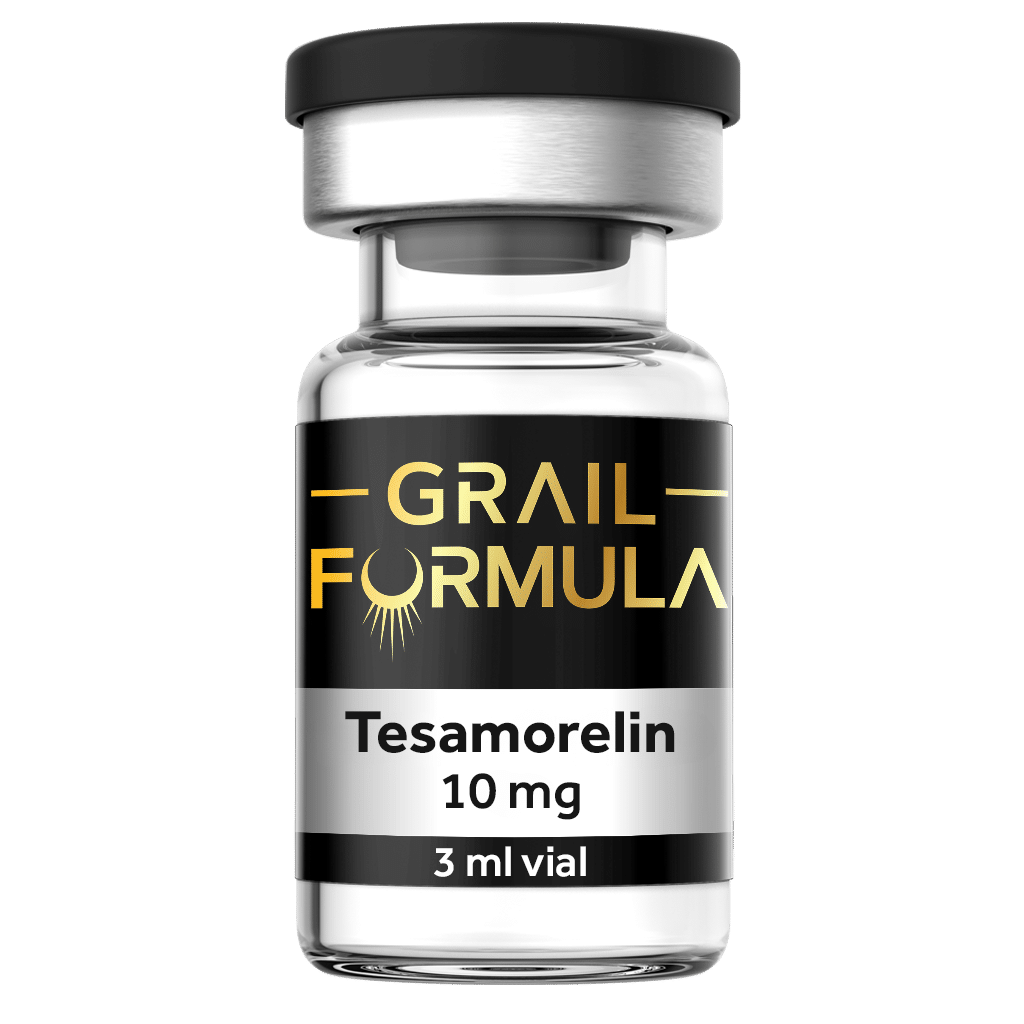
Tesamorelin 10mg
€ 79,00 Original price was: € 79,00.€ 69,00Current price is: € 69,00.
Tesamorelin 10 mg – Grail Formula Quality.
Researched and verified with Liquilabs s.r.o. Czechia.
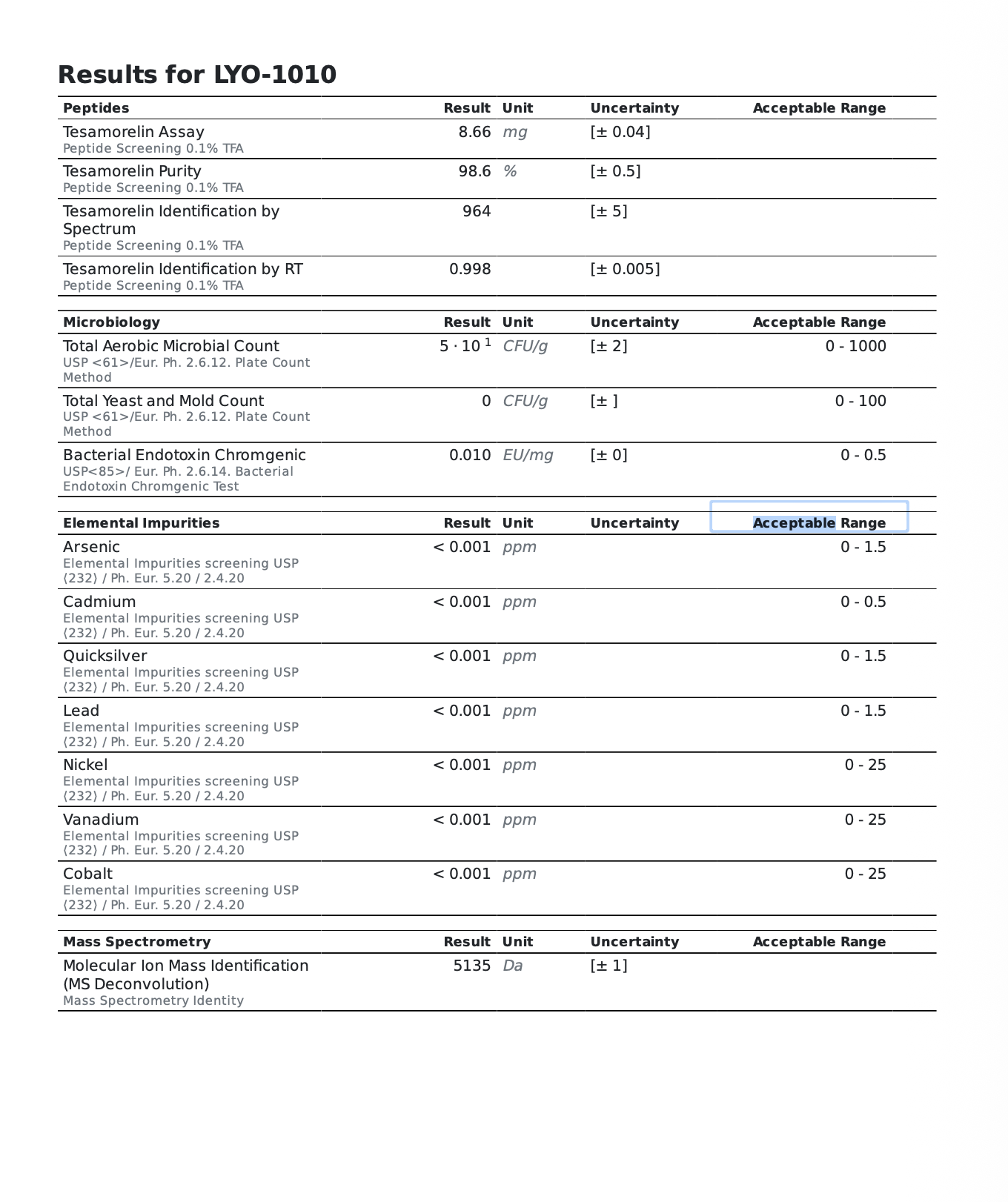
Analytical testing reports 98.6 % purity, assay content measured at 8.66 mg, molecular ion mass identified at 5135 Da, bacterial endotoxin measured at 0.010 EU/mg and total aerobic microbial count of 50 CFU/g.
Supplied as a nominal 10 mg synthetic GHRH analogue peptide research preparation with full batch-specific COA traceability.
For research use only — not for human or veterinary use.
Availability: In stock: ships within 1 day after payment confirmation.
Volume Discounts – the more you order, the more you save
5%
DISCOUNT
SPEND
€ 250+
10%
DISCOUNT
SPEND
€ 500+
15%
DISCOUNT
SPEND
€ 1.000+
20%
DISCOUNT
SPEND
€ 2.000+
25%
DISCOUNT
SPEND
€ 4.000+
Applied automatically at checkout based on your total cart value.
 | Secure Transaction |
Tesamorelin 10 mg is a synthetic peptide research compound supplied by Grail Formula for controlled laboratory investigation involving growth hormone-releasing hormone (GHRH) analogue biochemistry, molecular endocrinology, receptor-mediated signalling, peptide structure and experimental intracellular regulatory pathways.
Tesamorelin is a modified analogue of human growth hormone-releasing hormone, a peptide associated with the growth hormone-releasing hormone receptor (GHRHR). Its defined amino acid structure and molecular characteristics have made it a subject of scientific investigation in peptide chemistry, receptor biology and experimental endocrine signalling.
This preparation is supplied as a nominal 10 mg Tesamorelin research material, supported by independent batch-specific analytical documentation from Liquilabs s.r.o., Czechia. The measured assay content for this batch is 8.66 mg, which is below the nominal quantity.
For research use only — not for human or veterinary use.
Product Overview
Tesamorelin is a synthetic peptide analogue associated with the growth hormone-releasing hormone family of molecular signalling compounds. It is investigated in laboratory research involving peptide-receptor interactions, G protein-coupled receptor biology and endocrine-associated intracellular regulatory pathways.
Grail Formula supplies Tesamorelin 10 mg as a nominal 10 mg research preparation intended exclusively for controlled laboratory and in vitro scientific experimentation.
Independent third-party analytical testing was conducted by Liquilabs s.r.o., Czechia. The Certificate of Analysis, published on 11 October 2026, identifies production batch GF-TESA10-B242 and laboratory sample LYO-1010.
The analytical report documents a measured Tesamorelin assay content of 8.66 mg ± 0.04 mg and chromatographic purity of 98.6 % ± 0.5 percentage points.
The measured assay content is 1.34 mg below the nominal 10 mg designation, representing a shortfall of 13.4 %. This difference is disclosed separately from the chromatographic purity measurement.
The Certificate of Analysis also includes spectrum identification, retention time assessment, molecular ion mass identification, bacterial endotoxin testing, microbiological counts and elemental impurity screening.
Microbiological testing reported a total aerobic microbial count of 50 CFU/g, while the total yeast and mould count was 0 CFU/g. The measured aerobic count falls within the laboratory’s stated range of 0–1000 CFU/g but represents detectable microbial growth.
These measurements provide batch-specific analytical information about the tested peptide preparation. They do not independently establish biological activity, experimental potency, sterility or suitability for administration.
Peptide Overview
Tesamorelin is a synthetic analogue of growth hormone-releasing hormone, commonly abbreviated as GHRH. GHRH is a peptide signalling molecule investigated in molecular endocrinology because of its relationship with receptor-mediated intracellular signalling systems.
Tesamorelin contains a modified 44-amino-acid peptide structure based on the human GHRH sequence. Its N-terminal modification distinguishes it from the corresponding unmodified peptide and is relevant to investigations of peptide stability and molecular characteristics.
The peptide is studied in relation to the growth hormone-releasing hormone receptor, a member of the G protein-coupled receptor family.
G protein-coupled receptors are membrane-associated proteins involved in molecular communication between extracellular ligands and intracellular biochemical signalling networks.
Research involving Tesamorelin examines the relationship between peptide structure, receptor recognition and intracellular signalling mechanisms.
GHRH receptor-associated signalling is commonly investigated through pathways involving G proteins, adenylyl cyclase, cyclic adenosine monophosphate (cAMP) and downstream protein kinase-associated regulatory systems.
These pathways provide molecular frameworks for investigating how peptide ligands interact with receptor-associated intracellular processes under controlled experimental conditions.
Laboratory investigations may examine receptor binding characteristics, intracellular second messenger formation, signalling protein activity and changes in molecular regulatory markers.
Tesamorelin is also relevant to studies involving peptide structure-function relationships, analytical peptide chemistry and comparative investigations of modified GHRH analogues.
Its molecular structure provides a defined reference for investigating the relationship between amino acid sequence, chemical modification and analytical identity.
Research into peptide stability may examine how structural modifications influence molecular degradation, peptide conformation and chemical characteristics in experimental systems.
Such investigations require appropriate analytical methods and cannot be inferred solely from the presence of a modified amino acid sequence.
The Liquilabs Certificate of Analysis identifies a molecular ion mass of 5135 Da ± 1 Da, providing an identity-related analytical measurement for the tested peptide.
This molecular mass result is distinct from the measured assay content of 8.66 mg and chromatographic purity of 98.6 %.
The reported assay content describes the quantity of Tesamorelin measured in the tested preparation, while chromatographic purity describes the relative composition observed under the applied analytical conditions.
These measurements are complementary but should not be interpreted as interchangeable indicators of peptide quantity.
Historical Background and Scientific Context
The scientific background of Tesamorelin is connected to the development of peptide endocrinology, growth hormone-releasing hormone research and the broader investigation of receptor-mediated molecular signalling.
Early research into endocrine regulatory systems established that peptide molecules can participate in complex biochemical communication pathways.
Subsequent investigations contributed to the identification and characterisation of growth hormone-releasing hormone and its associated receptor signalling system.
The identification of GHRH provided a foundation for examining its molecular structure, amino acid sequence and interactions with receptor-associated biochemical pathways.
Researchers investigated the relationship between GHRH molecular characteristics and intracellular signalling processes, contributing to the development of experimental models in peptide endocrinology.
Advances in synthetic peptide chemistry subsequently enabled the production of modified GHRH analogues with defined molecular structures.
These synthetic analogues provided research materials for investigating peptide stability, receptor recognition and the relationship between chemical structure and molecular signalling behaviour.
Tesamorelin emerged from this broader field of modified GHRH peptide research.
Its structural modification became relevant to investigations involving peptide chemistry and the biochemical characteristics of synthetic GHRH-related compounds.
Scientific interest in GHRH analogues expanded alongside developments in receptor biology and intracellular signalling research.
G protein-coupled receptors became an important area of molecular investigation because of their involvement in numerous biochemical communication systems.
Research into GHRH receptor-associated pathways contributed to understanding how extracellular peptide ligands may interact with receptor proteins and intracellular signalling intermediates.
These investigations included studies of cyclic nucleotide signalling, G protein-associated molecular processes and downstream regulatory mechanisms.
Advances in molecular biology provided additional techniques for examining receptor-associated gene expression, signalling protein interactions and biochemical responses in experimental cellular systems.
Parallel developments in analytical chemistry improved the ability to characterise synthetic peptide research preparations.
Chromatographic techniques enabled researchers to investigate peptide separation, relative composition and quantitative content under defined analytical conditions.
Mass spectrometry provided complementary information about molecular identity and mass-related characteristics.
These analytical developments are particularly important when evaluating synthetic peptide materials because chemical purity and measured peptide quantity describe different properties.
A peptide preparation may exhibit relatively high chromatographic purity while containing less target peptide than its nominal labelled quantity.
The Liquilabs analysis of Tesamorelin 10 mg illustrates this distinction, reporting 98.6 % chromatographic purity alongside a measured assay content of 8.66 mg against the nominal 10 mg quantity.
Modern scientific research involving Tesamorelin continues to contribute to the broader investigation of peptide structure, GHRH-related receptor biology, molecular endocrinology and analytical peptide characterisation.
Published experimental findings must be interpreted according to their respective research models and cannot automatically be attributed to an independently manufactured peptide preparation.
Mechanistic Focus in Research
The principal mechanistic research interest surrounding Tesamorelin concerns its investigated relationship with GHRH receptor-associated signalling and intracellular regulatory pathways.
GHRH receptor-associated molecular signalling
Tesamorelin is investigated in relation to the growth hormone-releasing hormone receptor, a G protein-coupled receptor associated with molecular endocrine signalling.
Experimental research may examine interactions between GHRH-related peptide ligands and receptor-associated intracellular signalling components.
These investigations contribute to understanding ligand recognition, receptor-associated molecular responses and downstream biochemical regulation.
G protein-coupled receptor biology
G protein-coupled receptors participate in molecular communication between extracellular signalling molecules and intracellular biochemical networks.
Research involving GHRH-related peptides may examine receptor recognition, ligand-dependent conformational changes and G protein-associated signalling mechanisms.
The interpretation of these molecular interactions depends on the receptor model, experimental conditions and analytical endpoints employed.
Adenylyl cyclase and cyclic AMP signalling
GHRH receptor-associated pathways are commonly investigated in relation to adenylyl cyclase and cyclic adenosine monophosphate, also known as cAMP.
cAMP functions as an intracellular second messenger in numerous biochemical signalling systems.
Experimental investigations may examine changes in cAMP-associated molecular markers following controlled receptor-related laboratory experiments.
Such measurements provide information about intracellular signalling processes rather than independently establishing a complete biological response.
Protein kinase-associated regulatory pathways
Intracellular signalling networks frequently involve protein kinases and other regulatory proteins that participate in the transmission of molecular signals.
Research involving GHRH-related receptor pathways may examine phosphorylation-associated molecular events and downstream regulatory mechanisms.
These investigations contribute to understanding the relationship between receptor-associated signalling and intracellular biochemical regulation.
Peptide structure-function relationships
Tesamorelin contains a modified GHRH-related peptide structure that is relevant to research involving molecular recognition and peptide chemistry.
Experimental studies may compare structural characteristics of modified peptide analogues with corresponding unmodified peptide sequences.
Such investigations may examine peptide conformation, chemical stability, molecular degradation and receptor-associated recognition characteristics.
Analytical peptide characterisation
Tesamorelin is also relevant to research involving chromatographic separation, quantitative peptide analysis and mass spectrometric identity assessment.
Ultra-high-performance liquid chromatography can provide information about peptide composition and measured assay content.
Mass spectrometry can provide complementary molecular identity information through the analysis of mass-related characteristics.
The supplied Liquilabs Certificate of Analysis documents assay content, chromatographic purity, spectrum identification, retention time assessment and molecular ion mass identification.
However, the report does not contain GHRH receptor activation assays, cAMP response measurements, receptor binding experiments or other biological activity testing.
Accordingly, the mechanistic research topics described above represent scientific research areas associated with Tesamorelin rather than experimentally confirmed functional properties of batch GF-TESA10-B242.
Analytical Verification (COA)
Grail Formula provides independent batch-specific analytical documentation through testing conducted by Liquilabs s.r.o., Czechia.
The Certificate of Analysis for Tesamorelin 10 mg was published on 11 October 2026 and identifies production batch GF-TESA10-B242, laboratory sample LYO-1010.
The 13-page report includes peptide assay results, chromatographic purity assessment, spectrum identification, retention time assessment, mass spectrometry, bacterial endotoxin testing, microbiological counts and elemental impurity screening.
Peptide assay and chromatographic purity
- Nominal product quantity: 10 mg
- Measured Tesamorelin assay content: 8.66 mg ± 0.04 mg
- Reported chromatographic purity: 98.6 % ± 0.5 percentage points
- Measured assay difference from nominal quantity: 1.34 mg below the labelled 10 mg
- Measured assay as a proportion of nominal quantity: 86.6 %
- Analytical screening designation: Peptide Screening 0.1% TFA
The measured assay content is 13.4 % below the nominal 10 mg quantity. This is a notable batch-specific analytical finding and is disclosed independently of chromatographic purity.
The reported purity of 98.6 % describes the chromatographic composition under the applied analytical conditions. It does not mean that 98.6 % of the nominal 10 mg quantity was recovered.
The supporting analytical documentation includes chromatographic method specifications, calibration information and analytical records relating to peptide content and purity assessment.
Peptide identity assessment
- Spectrum identification result: 964 ± 5, as reported
- Retention time identification result: 0.998 ± 0.005, as reported
- Molecular ion mass identification: 5135 Da ± 1 Da
- Mass spectrometry identity assessment: MS deconvolution
The Certificate of Analysis includes chromatographic and mass spectrometric documentation supporting the analytical characterisation of the tested peptide.
The spectrum identification and retention time values are reproduced as reported. The summary does not provide separate explicit pass/fail interpretations for these measurements.
No separate FTIR-specific result is identified in the report summary. The spectrum identification value is therefore reported using the laboratory’s terminology without assigning an unconfirmed analytical technique.
The molecular ion mass of 5135 Da is an identity-related analytical result and is distinct from the measured peptide assay content expressed in milligrams.
Bacterial endotoxin assessment
- Bacterial endotoxin: 0.010 EU/mg
- Reported measurement uncertainty: ± 0 EU/mg
- Laboratory acceptable range: 0–0.5 EU/mg
- Analytical reference: USP <85> / European Pharmacopoeia 2.6.14
- Method: Chromogenic bacterial endotoxin testing
The bacterial endotoxin concentration of 0.010 EU/mg falls within the laboratory’s stated acceptable range of 0–0.5 EU/mg.
This is a measurable analytical result and must not be represented as the complete absence of bacterial endotoxins.
The endotoxin result does not establish sterility, biological safety or suitability for administration.
Microbiological assessment
- Total aerobic microbial count: 50 CFU/g (reported as 5 × 10¹ CFU/g)
- Reported aerobic count uncertainty: ± 2 CFU/g
- Total yeast and mould count: 0 CFU/g
- Reported aerobic microbial count range: 0–1000 CFU/g
- Reported yeast and mould count range: 0–100 CFU/g
- Analytical reference: USP <61> / European Pharmacopoeia 2.6.12
- Method: Plate-count testing
The total aerobic microbial count of 50 CFU/g represents measurable microbial growth in the tested sample.
Although this result falls within the laboratory’s stated acceptable range, it must not be described as zero microbial growth or as evidence of sterility.
The total yeast and mould count was reported as 0 CFU/g under the applied laboratory testing conditions.
Elemental impurity screening
Seven elemental impurities were evaluated using procedures referenced to USP <232> and European Pharmacopoeia 5.20 / 2.4.20.
- Arsenic: below 0.001 ppm
- Cadmium: below 0.001 ppm
- Mercury (listed as quicksilver): below 0.001 ppm
- Lead: below 0.001 ppm
- Nickel: below 0.001 ppm
- Vanadium: below 0.001 ppm
- Cobalt: below 0.001 ppm
All seven reported elemental impurity concentrations were below 0.001 ppm and within their respective laboratory acceptable ranges.
Results below the analytical reporting threshold indicate concentrations below that threshold rather than confirmation of absolute absence.
The complete Certificate of Analysis contains 13 pages of analytical findings and supporting documentation, including chromatographic records, mass spectrometric data, endotoxin determination information and microbiological testing methodology.
The reported findings relate exclusively to the tested sample and should not automatically be applied to unrelated production batches.
Research Applications
Tesamorelin is investigated in experimental peptide biochemistry, molecular endocrinology and research involving GHRH receptor-associated intracellular signalling.
Its scientific relevance arises from its modified GHRH-related molecular structure and its investigated relationship with receptor-mediated biochemical regulatory processes.
Potential areas of laboratory investigation include:
- GHRH analogue peptide biochemistry research
- Experimental molecular endocrinology investigations
- Growth hormone-releasing hormone receptor-associated signalling studies
- G protein-coupled receptor biology research
- Peptide-receptor recognition and ligand interaction investigations
- Adenylyl cyclase and cyclic AMP-associated molecular pathway studies
- Protein kinase-associated intracellular signalling research
- Comparative synthetic peptide structure-function investigations
- Peptide chemical stability and molecular characterisation studies
- Chromatographic purity and quantitative peptide analysis
- Mass spectrometric peptide identity assessment
These applications describe scientific research directions rather than demonstrated biological activity of the tested batch.
Experimental investigations require appropriate analytical controls, suitable reference materials and validated methods for evaluating peptide-associated molecular responses.
Batch-specific Certificate of Analysis documentation can support laboratory recordkeeping and provide researchers with information about the measured characteristics of the preparation.
Grail Formula Quality
Grail Formula focuses on supplying laboratory research compounds supported by transparent product information and independently documented analytical findings.
For Tesamorelin 10 mg, Liquilabs testing provides batch-specific information concerning peptide assay content, chromatographic purity, analytical identity, bacterial endotoxin concentration, microbiological counts and selected elemental impurities.
The report documents a measured assay content of 8.66 mg against the nominal 10 mg quantity, chromatographic purity of 98.6 % and bacterial endotoxin concentration of 0.010 EU/mg.
The assay shortfall of 13.4 % and measurable total aerobic microbial count of 50 CFU/g are disclosed transparently as part of the batch-specific analytical profile.
These measurements are presented separately to maintain a clear distinction between peptide quantity, chromatographic composition and microbiological characteristics.
Each result should be interpreted within the scope of the tested sample, the applied laboratory methodology and the reported measurement uncertainty.
When You Choose Grail Formula
Grail Formula provides Tesamorelin 10 mg with independent batch-specific analytical documentation from Liquilabs s.r.o., Czechia.
Researchers can review the Certificate of Analysis to examine the reported peptide assay, chromatographic purity, spectrum identification, retention time assessment, molecular ion mass, microbiological findings and elemental impurity results.
The report identifies the production batch, laboratory sample and publication date, supporting analytical traceability and laboratory documentation.
Grail Formula emphasises factual scientific descriptions, transparent reporting and clear distinctions between analytical measurements and biological properties that have not been established.
For laboratory research involving GHRH-related peptides, molecular endocrinology and receptor-associated cellular signalling, this documentation provides a reference for the measured characteristics of the tested Tesamorelin preparation.
Research Use Limitation
Used solely for in vitro experiments and cannot be:
- Used in clinical trials involving humans
- Administered to humans as part of an experiment or investigation
- Supplied to another party for human investigational use.
- Independently analysed by Liquilabs s.r.o. Czechia
- Synthetic GHRH analogue peptide research compound with nominal 10 mg quantity
- Chromatographic purity: 98.6 % ± 0.5 percentage points
- Assay content measured at 8.66 mg ± 0.04 mg
- Measured assay content 13.4 % below nominal quantity
- Identification evaluated by spectrum and retention time analysis
- Spectrum identification result: 964 ± 5
- Retention time identification result: 0.998 ± 0.005
- Molecular ion mass identified at 5135 Da ± 1 Da
- Bacterial endotoxin level of 0.010 EU/mg
- Total aerobic microbial count: 50 CFU/g
- Total yeast and mould count: 0 CFU/g
- All seven reported elemental impurities below 0.001 ppm
- Batch number: GF-TESA10-B242
- Laboratory sample identification: LYO-1010
- COA publication date: 11 October 2026
- Independent 13-page batch-specific Certificate of Analysis
- Investigated in GHRH analogue peptide biochemistry and molecular endocrinology research
- Relevant to controlled laboratory studies involving receptor-associated molecular signalling
- For research use only – not for human or veterinary use
For laboratory research only. Not intended for human consumption, injection, or cosmetic use.
This product is for research purposes only. Not for human use or diagnostic/therapeutic applications. Keep out of reach of children.
Third-Party Tested
Public COAs
Batch Verified
EU Shipping